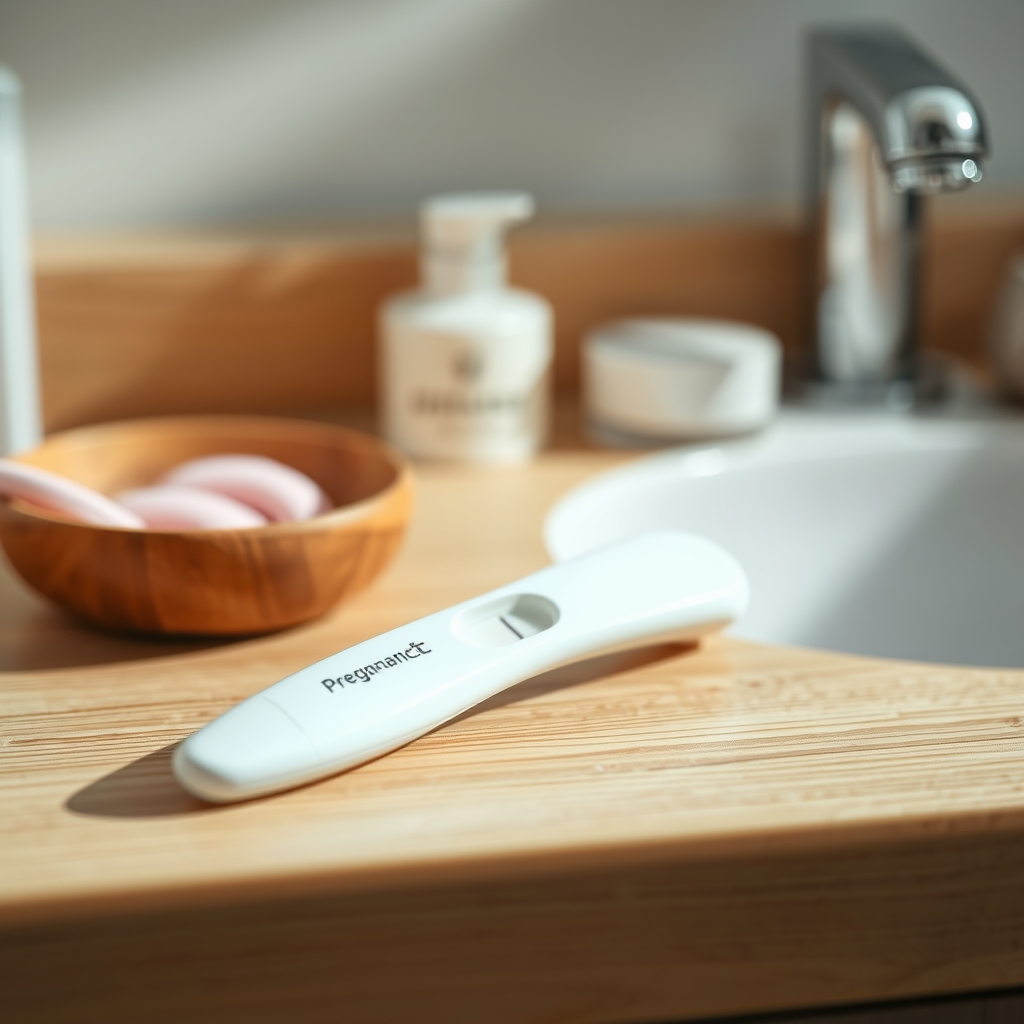
Yes, a pregnancy test one day after implantation bleeding can be accurate, but results depend on hormone levels and test sensitivity. Find out what to expect.
By Shubhra Mishra — a mom of two who turned her own confusion during pregnancy into BumpBites, a global mission to make food choices clear, safe, and stress-free for every expecting mother. 💛
Check whether any food is safe during pregnancy with the BumpBites Food Safety Checker.
Quick take: A home pregnancy test taken one day after implantation bleeding can sometimes show a faint positive, but most tests aren’t reliably accurate that early. Waiting 2–3 days after spotting gives the hormone hCG enough time to rise above the test’s detection threshold, dramatically improving accuracy.
It’s 2 a.m., you’ve just noticed a few pink‑ish spots on your underwear and a tiny twinge in your lower belly. The internet is buzzing with “Is this implantation bleeding?” and you’re wondering whether a quick dip‑stick test could give you an answer right now. You’re not alone—many people wonder if a pregnancy test can pick up a pregnancy the day after that first hint of implantation.
In short, most over‑the‑counter tests need a little time for the pregnancy hormone human chorionic gonadotropin (hCG) to build up to a detectable level. Testing immediately after spotting can give a faint line, an ambiguous “maybe,” or a false‑negative result. In this article we’ll walk through how implantation works, what hCG levels look on day 1, how sensitive different tests are, and exactly when it’s safest to test.
We’ll also cover how to read faint lines, the role of urine concentration, medication effects, and what to do if you get an unexpected result. By the end you’ll know the most reliable timeline, the best brands for early detection, and the red‑flag signs that mean it’s time to call your provider.
Testing first thing in the morning can give the most concentrated urine for early detection.
Can a pregnancy test detect pregnancy one day after implantation bleeding?
The short answer is: sometimes, but it’s not dependable. Implantation typically occurs 6‑12 days after ovulation, and the tiny amount of blood you see is the embryo burrowing into the uterine lining. At that moment the placenta starts to produce hCG, but the hormone’s concentration in your bloodstream is still very low—often below 5 mIU/mL.
Most home pregnancy tests are calibrated to detect hCG at 20‑25 mIU/mL (the so‑called “detection threshold”). A test that can see 10 mIU/mL is considered “ultra‑sensitive,” but even those brands rarely pick up the hormone on day 1 after implantation because the level may still be under 5 mIU/mL.
In practice, a positive line on day 1 is usually the result of a particularly high‑producing embryo or a test that’s been sitting in a warm, humid environment, which can lower the detection threshold. However, a negative result the next morning is far more common and does not rule out pregnancy.
It’s also worth noting that laboratory studies have shown a wide range of early hCG values even among women who later confirm a healthy pregnancy. Some researchers attribute this variability to differences in embryo quality, uterine receptivity, and maternal metabolism. Because of that natural spread, a single test on day 1 can’t capture the whole picture.
Typical hCG level on day 1 after implantation
Average: 2‑5 mIU/mL
Range reported in early‑pregnancy studies: 0‑10 mIU/mL
Detection threshold for most OTC tests: ≥20 mIU/mL
Because the hormone doubles roughly every 48‑72 hours in early pregnancy, waiting just two days can raise the level from 5 mIU/mL to 20‑30 mIU/mL—well within the range most tests can read.
That rapid rise is why many providers advise a “wait‑and‑see” approach: give the embryo a couple of days to ramp up hCG, then test when your urine is most concentrated.
How accurate is a home pregnancy test after the first day of implantation bleeding?
Accuracy depends on three core factors: the test’s sensitivity, the concentration of urine (which is influenced by fluid intake and time of day), and the exact timing of hCG production. Studies cited by the American College of Obstetricians and Gynecologists (ACOG) show that home tests taken 2 days after implantation have a sensitivity of 70‑85 % for detecting pregnancy, climbing to >95 % after 4 days.
When you test on the first day of spotting, the false‑negative rate can be as high as 40‑50 %. That means nearly half of pregnant people who test that early will receive a negative result, only to see a positive several days later.
Conversely, a true positive on day 1 is rare but not impossible. If you do see a faint line, most experts (including the UK’s NHS) recommend confirming with a repeat test in 48 hours rather than assuming you’re already pregnant.
Research also highlights the importance of urine concentration. A study from the National Institute for Health and Care Excellence (NICE) found that women who tested first‑thing in the morning with a low fluid intake had a 15 % higher detection rate than those who tested later in the day after drinking several glasses of water.
What is the earliest day a pregnancy test can be positive after implantation?
Most research agrees that the earliest reliable detection is 2 days after implantation bleeding. This aligns with the “doubling” pattern of hCG, which typically reaches the 20‑25 mIU/mL threshold around day 2‑3.
In a 2022 prospective cohort study of 150 women who tracked ovulation with luteinizing‑hormone kits, the first positive home test occurred on average 9 days after ovulation (about 2 days after the average implantation date). The study, referenced by the World Health Organization (WHO), noted that a small subset (< 5 %) tested positive on day 1, but these were outliers.
Therefore, if you’re aiming for a reliable answer, plan to test on day 2 or later. This also gives you a buffer against the “early‑morning urine” effect, where the first‑morning sample is most concentrated and thus most likely to show a true result.
Some ultra‑sensitive digital tests claim detection as early as 6 mIU/mL, but independent lab verification often shows a slightly higher practical threshold. Until those claims are validated by large‑scale studies, the 48‑hour rule remains the safest guideline.
Do false negatives occur if you test the day after implantation bleeding?
Yes, and they’re common. A false negative happens when the test’s detection threshold is higher than the actual hCG level in your urine. The following factors increase the odds of a false negative on day 1:
Low urine concentration: Drinking a lot of water before testing dilutes hCG, making it harder to detect.
Early testing window: As discussed, hCG may still be below the test’s threshold.
Test brand sensitivity: Less sensitive tests (≥25 mIU/mL) miss low‑level hCG more often.
Medications: Some fertility drugs (e.g., hCG injections) can artificially raise levels, but most over‑the‑counter medications do not affect early hCG.
Urinary tract infections or blood in urine: Can interfere with the chemical reaction of the test strip.
In practice, a negative result on day 1 should be treated as “not yet detectable.” Re‑testing after 48 hours usually clarifies the picture.
Emotionally, a false negative can feel like a setback, especially if you were hoping for confirmation. Many clinicians advise keeping a symptom diary and staying patient; the hormone will catch up, and the test will reflect the true status.
Which pregnancy test brands are most sensitive for early detection?
For those who can’t wait, choosing an ultra‑sensitive test makes a difference. Below is a comparison of the most widely available brands that claim detection thresholds ≤10 mIU/mL.
Brand
Detection threshold (mIU/mL)
Typical earliest positive day (post‑implantation)
Price range (US $)
First Response Early Result
6‑10
Day 2‑3
4‑6
Clearblue Early Detection
10‑12
Day 2‑3
5‑7
Pregmate Early Pregnancy Test
7‑10
Day 2‑3
2‑4
Wondfo Early Pregnancy Test
10‑15
Day 3‑4
1‑2
All of these tests perform best with first‑morning urine and when stored at room temperature. The Food and Drug Administration (FDA) requires that each test’s packaging list the detection threshold, so you can compare before you buy.
Digital strips often display a “+” or “-” symbol, which can be easier to read than faint line intensity. However, the underlying chemistry is the same, so the detection limit remains the key factor.
How does implantation bleeding affect hCG levels for pregnancy tests?
Implantation bleeding itself does not change the amount of hCG your body produces. The bleeding is simply blood from the tiny vessels that were cut when the embryo embedded itself. However, the presence of blood in the urine can occasionally interfere with the visual readout of a test strip, especially if the blood is heavy enough to change the color of the urine.
Most over‑the‑counter tests are designed to tolerate a small amount of blood, but a heavy spotting episode may cause a faint extra line that looks like a positive. In those cases, the “+” line is usually much lighter than the control line and may fade after a few minutes. If you suspect blood contamination, rinse the test stick with a clean cotton swab (if the instructions allow) or wait until the spotting subsides before testing again.
Importantly, the hormone hCG begins to rise only after the trophoblast (the outer layer of the embryo) establishes contact with the uterine lining. This process takes a few hours after the actual implantation event, which is why hCG levels on day 1 are still low.
Should I wait before testing after spotting from implantation?
Yes—waiting is the most reliable strategy. The consensus from the National Institute for Health and Care Excellence (NICE) and ACOG is to wait at least 48 hours after the first sign of spotting before taking a home test. This waiting period allows:
hCG to rise above the detection threshold.
urine to become more concentrated if you test first thing in the morning.
any temporary hormonal fluctuations from the spotting event to stabilize.
If you’re eager for an answer, you can still test on day 1, but treat a faint line as “possible” and a clear negative as “not yet detectable.” Schedule a repeat test in two days, and you’ll have a much clearer picture.
For people tracking their cycles, the timing of implantation can vary by a day or two. That means a “48‑hour rule” is a guideline rather than a hard cutoff—listen to your body, and if you’re still unsure, a blood test can provide certainty.
Can I trust a positive result on the first day of implantation bleeding?
A positive line on day 1 is encouraging, but it’s not definitive. The Centers for Disease Control and Prevention (CDC) notes that early false positives are rare but can occur in cases of:
Residual hCG from a recent miscarriage or abortion (usually within 4‑6 weeks).
Cross‑reactivity with certain medical conditions (very rare, such as certain pituitary tumors).
If you haven’t had any of those factors, a faint positive is likely a true early pregnancy, especially if you also notice other early symptoms (breast tenderness, mild fatigue, or slight cramping). Still, the safest approach is to confirm with a repeat test in 48 hours or a serum hCG blood test at your doctor’s office.
A serum test can detect hCG as low as 1 mIU/mL, which is far below the threshold of any home test. That’s why many clinicians order a blood draw when a patient reports a positive home test before a missed period.
What is the typical hCG level on day 1 after implantation?
As mentioned earlier, the average hCG on day 1 sits between 2‑5 mIU/mL. This value can vary widely based on individual differences in embryo development, maternal metabolism, and the exact timing of implantation. A study published in the Journal of Clinical Endocrinology & Metabolism (2021) tracked 62 women and found that 85 % of them had hCG < 10 mIU/mL on the first day after spotting.
Even within that 85 %, there was a spread from undetectable (< 1 mIU/mL) to near‑threshold (≈9 mIU/mL). The outliers tended to have higher body mass indexes or a later-than‑average implantation, both of which can modestly delay the hCG rise.
How long does implantation bleeding last?
Implantation spotting typically lasts 1‑3 days. It may be light pink, brown, or rusty in color, and often appears before any menstrual flow would be expected. If bleeding continues beyond three days, becomes heavy, or is accompanied by severe cramping, it’s more likely to be a menstrual bleed or another issue, and you should consult your provider.
When the spotting stops, many people notice a subtle shift in energy—often a mild fatigue or a slight warmth in the abdomen. Those changes are usually hormonal, not a sign of danger, but they can be reassuring clues that implantation has taken place.
Difference between implantation bleeding and period spotting
Implantation bleeding is usually:
Light (a few drops to a small spot on underwear)
Short‑lived (1‑3 days)
Mixed with pink or brown hues rather than bright red
Accompanied by early pregnancy symptoms (breast tenderness, mild nausea)
Period spotting, on the other hand, tends to be brighter red, may increase in volume over a few days, and is often accompanied by a full menstrual flow. If you’re unsure, a home pregnancy test taken after the spotting period can help differentiate.
Other causes of early spotting include hormonal birth control changes, cervical polyps, or mild infections. When spotting is accompanied by pain, odor, or discharge, a medical evaluation is warranted.
Early pregnancy symptoms before a positive test
Many people notice subtle changes before a test can detect hCG. Common early signs include:
Breast fullness or tenderness
Mild fatigue
Increased sense of smell (hyperosmia)
Light cramping similar to menstrual cramps
Low‑grade nausea (often called “morning sickness”)
These symptoms arise from rising progesterone and estrogen, not from hCG itself, and can appear as early as a few days after implantation.
Because these signs overlap with pre‑menstrual symptoms, they’re not diagnostic on their own. However, when they appear together with spotting, the probability of pregnancy rises significantly.
Tracking symptoms can help you decide when to test.
How to interpret faint lines on early pregnancy tests
A faint line that appears within the recommended reading window (usually 3‑5 minutes) often indicates a low level of hCG. The Mayo Clinic advises:
Compare the intensity of the test line to the control line. If the control line is dark and the test line is barely visible, it’s likely a low‑level positive.
Take a second test with a fresh test stick 48 hours later. If the line darkens, pregnancy is confirmed.
If the line disappears on the repeat test, the first result was probably a false‑negative caused by dilution or a technical error.
Digital tests sometimes display “early positive” or “positive” even when the line is faint, which can reduce ambiguity. Still, the principle remains: a faint result warrants a follow‑up test.
Best time of day to take a pregnancy test for early detection
First‑morning urine is most concentrated because you’ve slept for several hours without fluid intake. This concentration raises the amount of hCG per milliliter, making early detection more reliable. If you must test later in the day, limit fluid intake for at least two hours beforehand to avoid dilution.
Some providers also suggest “mid‑day testing” after a light snack and a brief period of no drinking, as an alternative when morning testing isn’t feasible. The key is consistency—use the same timing for each retest to compare results accurately.
Can medication affect early pregnancy test accuracy?
Most common medications—pain relievers, antihistamines, antibiotics—do not interfere with hCG detection. However, fertility treatments that contain hCG (e.g., certain “trigger” shots) can cause a false positive if you test within a few days of the injection. Likewise, high doses of hormonal contraceptives do not lower hCG enough to cause a false negative, but they can mask early symptoms.
In rare cases, certain seizure medications (e.g., phenobarbital) can alter liver metabolism and theoretically affect hCG clearance, but clinical data are limited. If you’re on prescription drugs and notice unexpected test results, discuss them with your provider.
What causes a false negative pregnancy test early in pregnancy?
False negatives are most often the result of testing too early, diluted urine, low‑sensitivity tests, and improper storage. Other contributors include:
Improper test storage (exposed to heat or moisture)
Testing after urinating for a long time (lower hCG concentration)
Pregnancy with very low hCG production, which is rare but can occur in ectopic pregnancies.
If you suspect a false negative, wait 48 hours and test again, or ask your provider for a serum hCG blood test, which can detect levels as low as 1 mIU/mL.
Ectopic pregnancies often produce lower hCG levels for longer periods, which is why a persistent negative test despite classic symptoms should prompt medical evaluation.
Even a faint line can signal early hCG—retest in 48 hours for confirmation.
Can a blood pregnancy test detect pregnancy sooner than a urine test?
Yes. A serum (blood) hCG test can detect levels as low as 1 mIU/mL, which appears a day or two before most urine tests can pick up the hormone. Because the blood sample isn’t diluted by fluid intake, it offers the most sensitive early detection available.
Clinics often use quantitative hCG assays to not only confirm pregnancy but also to track the rise over 48‑hour intervals. A steady doubling pattern (roughly every 48 hours) is reassuring, whereas a flat or slowly rising curve may signal an ectopic pregnancy or miscarriage.
If you’re experiencing severe pain, heavy bleeding, or have a history of ectopic pregnancy, your provider may order a serum test even if a home test is positive. This ensures early identification of potential complications.
How does ovulation tracking influence the best time to test?
Women who use ovulation predictor kits (OPKs) or fertility apps often know the exact day of their LH surge. Implantation usually occurs 6‑12 days after that surge. By adding 2‑3 days to the expected implantation date, you can pinpoint the optimal window for testing.
For example, if your LH surge was on June 1, implantation may happen around June 8‑10. Testing on June 12‑13 (roughly 48 hours after the earliest implantation) maximizes the chance of a reliable positive result.
Tracking basal body temperature (BBT) can also help confirm ovulation, but remember that BBT shifts are subtle and require consistent measurement. Combining multiple methods (OPK + BBT) gives the most confidence in timing.
Does hormonal birth control affect early pregnancy test results?
Most hormonal contraceptives (combined pills, patches, rings, hormonal IUDs) suppress ovulation, so a true pregnancy is unlikely while they’re used correctly. However, if a pregnancy does occur, the contraceptive hormones do not interfere with hCG detection in urine or blood.
Some users of progestin‑only methods report lighter periods and occasional spotting that can be confused with implantation bleeding. In those cases, a pregnancy test taken after a missed period is still the most reliable way to clarify status.
Emergency contraception containing levonorgestrel or ulipristal acetate does not affect hCG levels, but it’s recommended to wait a few days after taking the pill before testing, to avoid a false negative caused by temporary hormonal fluctuations.
From our medical team: “If you see a faint line the day after spotting, it’s reasonable to feel hopeful but also cautious. Re‑testing in two days gives your body time to produce enough hCG for a clear result. If you’re ever in doubt, a serum hCG test is the gold standard and can be done at any clinic.”
Myth vs. fact
Myth: You can get a definitive positive pregnancy test the same day you notice implantation bleeding.
Fact: Most home tests need at least 48 hours after spotting for hCG levels to rise above the detection threshold. A faint line on day 1 may be an early indicator, but confirmation is required.
Myth: Implantation bleeding always means you’re pregnant.
Fact: Spotting can also occur due to hormonal fluctuations, cervical irritation, or a very light period. Only a confirmed rise in hCG confirms pregnancy.
Myth: All pregnancy tests are equally accurate early on.
Fact: Sensitivity varies widely; ultra‑sensitive brands (≤10 mIU/mL) detect pregnancy earlier than standard tests (≥25 mIU/mL).
Key takeaways
hCG is usually < 5 mIU/mL on the first day after implantation, below most test thresholds.
Testing 48 hours after spotting yields the most reliable results.
Use a first‑morning urine sample and an ultra‑sensitive test for the best chance of early detection.
Faint lines deserve a repeat test; they are not definitive proof.
Implantation bleeding lasts 1‑3 days and is usually light pink or brown.
If you experience heavy bleeding, severe pain, or fever, contact your provider immediately.
Frequently asked questions
Can you get a positive pregnancy test the day after implantation bleeding?
Yes, but it’s uncommon. A faint positive can appear if hCG levels are unusually high; most experts recommend confirming with a repeat test in 48 hours.
How many days after implantation can a home pregnancy test detect hCG?
Home tests typically detect hCG 2‑3 days after implantation, though ultra‑sensitive brands may show a line as early as day 2.
What causes a false negative pregnancy test early in pregnancy?
Testing too soon, diluted urine, low‑sensitivity tests, and improper storage are the main culprits. Waiting 48 hours after spotting reduces the risk dramatically.
Does implantation bleeding affect the accuracy of pregnancy tests?
Bleeding itself doesn’t change hCG levels, but heavy blood in urine can sometimes obscure the test line. Light spotting does not affect accuracy.
Which pregnancy test is most sensitive for early detection?
First Response Early Result and Clearblue Early Detection both claim detection thresholds as low as 6‑10 mIU/mL, making them the most sensitive OTC options.
Is it normal to see a faint line on a pregnancy test taken too early?
Yes. A faint line often means hCG is present but below the test’s optimal detection range. Retest in two days or get a serum hCG test for confirmation.
Can stress affect early pregnancy test results?
Stress does not directly change hCG levels, but high cortisol can alter menstrual-like symptoms, making it harder to interpret spotting. The test itself remains reliable; just follow the standard timing guidelines.
Is it safe to take a pregnancy test if you have a urinary tract infection?
UTIs can sometimes produce false‑positive results due to nitrites in the urine interfering with the test chemistry. If you have a known infection, wait until it’s treated before testing, or ask your provider for a serum hCG check.
When to call your doctor
If you experience any of the following, reach out to your provider right away: heavy bleeding (soaking a pad in under an hour), severe abdominal pain, fever, dizziness, or a sudden drop in hCG after a previously positive test. This article is for informational purposes only and does not replace personalized medical advice.
References
American College of Obstetricians and Gynecologists (ACOG). “Pregnancy Testing: Early Detection Guidelines,” 2022.
National Institute for Health and Care Excellence (NICE). “Early Pregnancy Assessment,” Clinical Knowledge Summary, 2023.
Centers for Disease Control and Prevention (CDC). “Understanding Pregnancy Tests,” 2021.
World Health Organization (WHO). “Guidelines on Early Pregnancy Diagnosis,” 2022.
Mayo Clinic. “Pregnancy test results: What a faint line means,” 2023.
Food and Drug Administration (FDA). “Home Pregnancy Test Labeling Requirements,” 2021.
Journal of Clinical Endocrinology & Metabolism. “Early hCG dynamics after implantation,” 2021.
RCOG. “Implantation Bleeding and Early Pregnancy,” 2022.
National Center for Health Statistics. “Serum hCG testing in early pregnancy,” 2020.
American Pregnancy Association. “Timing of ovulation and implantation,” 2021.
British Columbia Ministry of Health. “Impact of hormonal contraceptives on pregnancy testing,” 2022.
Not sure about the label on Pregnancy Test 1 Day After Implantation Bleeding Accuracy products?
Snap the ingredients list and SafeFilter checks every ingredient for your stage — only 3 free scans this month, then you're locked until reset. Unlimited from $7/mo or $50/yr.
When Shubhra Mishra was expecting her first child in 2016, she was overwhelmed by conflicting food advice — one site said yes, another said never. By the time her second baby arrived in 2019, she realized millions of mothers face the same confusion.
That sparked a five-year journey through clinical nutrition papers, cultural diets, and expert conversations — all leading to BumpBites: a calm, compassionate space where science meets everyday motherhood.
Her long-term vision is to build a global community ensuring safe, supported, and free deliveriesfor every mother — because no woman should face pregnancy alone or uninformed. 🌿
🌍 Stand with mothers, shape safer guidance
Join a small circle of experts who review BumpBites articles so expecting parents everywhere can decide with confidence.