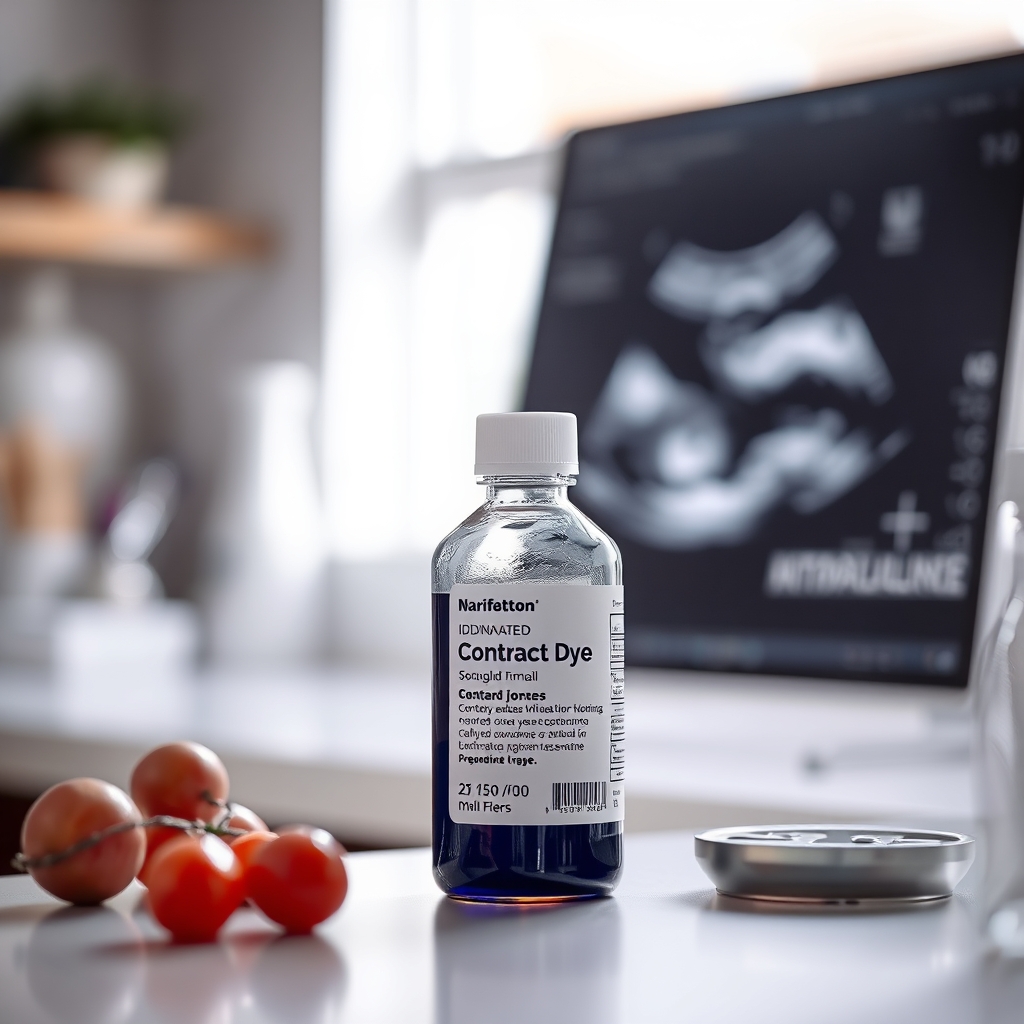
Limit contrast dye during pregnancy. Experts recommend avoiding it in the first trimester unless medically necessary, with minimal safe dosage for diagnostic imaging.
By Shubhra Mishra — a mom of two who turned her own confusion during pregnancy into BumpBites, a global mission to make food choices clear, safe, and stress-free for every expecting mother. 💛
Check whether any food is safe during pregnancy with the BumpBites Food Safety Checker.
Quick verdict: ⚠️ Safe with limits – contrast dye can be used when medically necessary, but only at the lowest effective dose and after careful discussion with your provider. The safest approach is to avoid gadolinium‑based agents whenever possible and reserve iodinated contrast for essential imaging.
It’s 2 a.m., you’re scrolling through a medical forum, and the headline “Is contrast dye safe during pregnancy?” pops up. Your heart races because you’ve just been scheduled for a CT scan that requires contrast, and you’re not sure whether the dye could harm your developing baby. You’re not alone—many expectant parents wonder the same thing, especially after a radiology order lands on their doorstep.
We’ve sifted through the latest guidance from the American College of Obstetricians and Gynecologists (ACOG), the UK’s NHS, and the U.S. Food and Drug Administration (FDA) to give you a clear, evidence‑based answer. In short, the answer to “is contrast dye safe during pregnancy” is: it can be safe when the benefit outweighs the risk, but the type of dye, the trimester, and the dose all matter. Below you’ll find the verdict broken down by trimester, dosage recommendations, safer imaging alternatives, brand considerations, and what to watch out for.
Read on for a step‑by‑step guide that lets you stop worrying, talk confidently with your radiologist, and make the best decision for you and your baby.
Stage of pregnancy
Verdict
Notes
First trimester (0‑13 weeks)
⚠️ Use only if essential
Iodinated contrast may be used at lowest dose; gadolinium generally avoided.
Second trimester (14‑27 weeks)
⚠️ Use with caution
Iodinated agents acceptable for necessary studies; gadolinium still discouraged.
Third trimester (28‑40 weeks)
⚠️ Use with caution
Same guidance as second trimester; monitor fetal thyroid function if iodinated dye used.
Breastfeeding
✅ Generally safe
Most contrast agents have minimal transfer into breast milk; pause feeding for 24 hrs if advised.
When contrast is needed, the lowest effective dose and the safest brand can make a difference.
What is contrast dye?
Contrast dye, also called contrast media, is a chemical substance injected into a patient’s bloodstream or administered orally to improve the visibility of internal structures during imaging studies such as CT scans, X‑rays, and MRIs. There are two main families used in clinical practice: iodinated contrast agents, which contain iodine and are typically employed for X‑ray‑based imaging, and gadolinium‑based contrast agents (GBCAs), which contain the rare earth metal gadolinium and are used primarily for magnetic resonance imaging (MRI). Iodinated agents work by absorbing X‑rays, making blood vessels and organs appear brighter on the scan, while gadolinium alters the magnetic properties of nearby water molecules, enhancing the signal on MRI.
These agents are valuable because they can reveal subtle abnormalities—such as small vascular lesions, tumors, or inflammatory changes—that might be missed without contrast. However, because they circulate through the mother’s bloodstream and can cross the placenta to some extent, their safety profile in pregnancy is a key concern for both patients and providers.
Is contrast dye safe during pregnancy?
Current guidance from ACOG and the NHS states that iodinated contrast agents are “Category B” (no evidence of risk in animal studies, but no controlled human studies), meaning they can be used when the diagnostic benefit outweighs the potential risk. The FDA classifies most modern, low‑osmolality iodinated agents as “generally safe” for pregnant patients if clinically indicated. Gadolinium‑based agents, however, are classified as “Category C” by the FDA, indicating potential risk to the fetus, and ACOG advises that they should be avoided unless absolutely necessary.
The primary theoretical risk of iodinated contrast is fetal thyroid suppression. Iodine can cross the placenta, and excess iodine may temporarily inhibit the fetal thyroid gland, potentially leading to neonatal hypothyroidism. Studies have shown that when low‑dose, low‑osmolality agents are used, the incidence of clinically significant thyroid dysfunction is very low, especially when the mother’s iodine intake is otherwise adequate. The risk is highest in the first trimester, the period of organogenesis, when the fetal thyroid begins to develop.
Gadolinium agents have a higher molecular weight and can cross the placenta more readily, raising concerns about gadolinium deposition in fetal tissues. Limited animal data suggest a potential for teratogenic effects, and human data are sparse. Consequently, most obstetric societies recommend reserving gadolinium for situations where the imaging information cannot be obtained by any other means.
In short, the answer to “is contrast dye safe during pregnancy” depends on the type of dye, the timing, and the clinical necessity. Iodinated contrast can be safe when used sparingly and with proper monitoring, while gadolinium should be avoided unless there is no alternative.
Is contrast dye safe in the first trimester of pregnancy?
During the first trimester, the embryo undergoes organogenesis, making it the most vulnerable period for teratogenic exposures. ACOG advises that iodinated contrast may be used only if the diagnostic information is critical and cannot be obtained by non‑contrast imaging. If an iodinated study is unavoidable, the lowest effective dose should be administered, and the mother’s iodine status should be assessed to minimize thyroid suppression risk.
Gadolinium‑based agents are generally discouraged in the first trimester due to the lack of safety data and the possibility of crossing the placenta. The NHS echoes this stance, recommending alternative imaging modalities whenever possible. If a first‑trimester scan with contrast is deemed essential, the radiology team should document the justification and discuss potential fetal thyroid monitoring after the exam.
What is the recommended dosage of iodinated contrast dye for pregnant patients?
For pregnant patients, the recommended dosage of iodinated contrast is the same as in non‑pregnant adults but capped at the lowest effective amount. Most low‑osmolality agents, such as iohexol (Omnipaque) or iopamidol (Isovue), are administered at 1–2 mL kg⁻¹, typically not exceeding 150 mL for a standard CT scan. The FDA’s labeling advises using the minimum volume needed for adequate imaging, and ACOG recommends a “dose‑as‑low‑as‑reasonably‑achievable” (ALARA) approach.
If the patient has renal insufficiency—a condition that can be exacerbated by contrast—dose reduction to 0.5 mL kg⁻¹ or the use of alternative, non‑contrast imaging is advised. For gadolinium‑based agents, the standard adult dose is 0.1 mmol kg⁻¹ (approximately 0.2 mL kg⁻¹), but ACOG suggests avoiding gadolinium entirely in pregnancy unless no other imaging can answer the clinical question.
Are gadolinium‑based contrast agents safe during pregnancy?
Gadolinium‑based contrast agents are not considered safe for routine use in pregnancy. The FDA places most GBCAs in Category C, indicating that risk cannot be ruled out, and ACOG advises that they should be used only when the diagnostic benefit clearly outweighs the potential fetal risk. The primary concern is that gadolinium can cross the placenta and accumulate in fetal tissues, with animal studies suggesting possible developmental toxicity.
When a gadolinium‑enhanced MRI is absolutely necessary—such as for detailed evaluation of a suspected central nervous system lesion—providers should choose macrocyclic agents (e.g., gadobutrol) over linear agents, as macrocyclic compounds have a tighter chelate structure and lower propensity for gadolinium release. Even then, the lowest effective dose is recommended, and the patient should be counseled on the limited data regarding fetal outcomes.
What are the risks of using contrast dye during pregnancy?
Fetal thyroid suppression: Iodinated contrast can temporarily inhibit the fetal thyroid, potentially leading to neonatal hypothyroidism if excess iodine is absorbed.
Potential teratogenicity: Gadolinium agents have shown developmental toxicity in animal studies, raising concerns about birth defects, though human data are limited.
Nephrotoxicity: Both iodinated and gadolinium agents can worsen kidney function in mothers with pre‑existing renal disease, indirectly affecting fetal health.
Allergic reactions: Maternal hypersensitivity can lead to anaphylactoid reactions, which require immediate medical attention.
Most of these risks are mitigated by using the lowest effective dose, selecting low‑osmolality iodinated agents, and avoiding gadolinium whenever possible. Post‑procedure monitoring of maternal renal function and fetal thyroid status (via neonatal TSH screening) is often recommended when iodinated contrast is used.
Can I have an MRI with contrast dye while pregnant?
Non‑contrast MRI is considered safe throughout pregnancy and is the preferred method when soft‑tissue detail is needed. If a contrast‑enhanced MRI is contemplated, the decision should be made jointly by the obstetrician, radiologist, and patient, weighing the urgency of the diagnostic information against the potential fetal exposure. ACOG and the NHS both advise that gadolinium‑based contrast should be avoided unless no alternative can provide the required diagnostic clarity.
When a contrast‑enhanced MRI is performed, the radiology team typically uses a macrocyclic gadolinium agent at the minimal dose and monitors the mother for any adverse reactions. Fetal monitoring is not routinely required during the scan, but a follow‑up pediatric thyroid function test may be advised if iodinated contrast was used.
Safer imaging alternatives to contrast dye for pregnant women
Ultrasound imaging – No radiation or contrast; excellent for obstetric and many abdominal assessments.
Non‑contrast MRI – Provides high‑resolution soft‑tissue detail without gadolinium.
Low‑dose CT scan (no contrast) – Can be considered for specific bone or lung evaluations where radiation dose is minimized.
MRI with diffusion‑weighted imaging – Offers functional information without the need for gadolinium.
X‑ray with lead shielding – Useful for skeletal assessments, with shielding to protect the fetus.
Digital breast tomosynthesis (no contrast) – Safe for breast evaluation when needed during pregnancy.
Which brand of contrast dye is considered safest for pregnant patients?
When iodinated contrast is required, low‑osmolality, non‑ionic agents such as iohexol (brand name Omnipaque) and iopamidol (Isovue) are preferred because they have a lower incidence of adverse reactions and lower osmolar load, which reduces the risk of renal stress. For gadolinium‑based agents, macrocyclic compounds like gadobutrol (Gadavist) are considered safer than linear agents, though they are still generally avoided in pregnancy.
Regardless of brand, the key is to use the smallest dose that yields diagnostic quality images and to ensure the patient’s renal function is adequate (eGFR ≥ 60 mL/min/1.73 m²) before administration.
How does contrast dye affect fetal development?
Fetal development can be subtly impacted by contrast exposure, primarily through thyroid function alteration with iodinated agents and potential tissue deposition with gadolinium. In the majority of documented cases, no major congenital anomalies have been linked to low‑dose iodinated contrast, especially when used after the first trimester. However, isolated reports of transient neonatal hypothyroidism have prompted recommendations for newborn thyroid screening when maternal iodinated contrast is administered after 20 weeks gestation.
Gadolinium exposure remains more concerning; animal studies have suggested skeletal and organ development effects, but human data are insufficient to draw definitive conclusions. Because of this uncertainty, the consensus among obstetric societies is to avoid gadolinium unless the diagnostic benefit is unequivocal.
When contrast isn’t essential, non‑contrast MRI often provides the needed answers.
Safe dosage / amount / brands
For iodinated contrast agents, the recommended adult dose is 1–2 mL kg⁻¹, not exceeding 150 mL for a typical CT scan. In pregnancy, clinicians aim for the lowest effective volume—often 80–100 mL—especially in women with borderline renal function. Low‑osmolality, non‑ionic brands such as Omnipaque (iohexol) and Isovue (iopamidol) are preferred for their safety profile.
Gadolinium‑based agents are dosed at 0.1 mmol kg⁻¹ (≈ 0.2 mL kg⁻¹). If an MRI with gadolinium is unavoidable, macrocyclic agents like Gadavist (gadobutrol) are the safest option, but the dose should still be limited to the minimum required for diagnostic clarity.
Patients with pre‑existing kidney disease should have their serum creatinine checked before any contrast administration. If eGFR is below 60 mL/min/1.73 m², both iodinated and gadolinium agents carry a higher risk of nephrotoxicity, and alternative imaging without contrast should be strongly considered.
Side effects and risks
Common, usually mild reactions: Warmth or flushing at the injection site, mild nausea, and a transient metallic taste. These symptoms typically resolve on their own and do not affect the fetus.
Allergic‑type reactions: Hives, itching, or shortness of breath can occur in a small percentage of patients. Severe anaphylactoid reactions are rare (< 0.01 %) but require immediate emergency treatment.
Fetal thyroid suppression: Excess iodine from iodinated contrast can lead to temporary neonatal hypothyroidism. Newborn TSH screening is recommended if iodinated contrast was used after 20 weeks gestation.
Potential gadolinium toxicity: Although rare, gadolinium can deposit in fetal tissues and has been associated with developmental toxicity in animal models. This underlies the recommendation to avoid gadolinium unless absolutely necessary.
If you experience any of the following after contrast administration, contact your healthcare provider right away: severe headache, persistent vomiting, rapid heartbeat, swelling of the face or throat, or decreased fetal movement.
Safer alternatives
Ultrasound imaging – No contrast or radiation, ideal for abdominal and obstetric assessments.
Non‑contrast MRI – Provides detailed soft‑tissue images without gadolinium.
Low‑dose CT (no contrast) – Useful for bone or lung evaluation when radiation is minimized.
MRI with diffusion‑weighted imaging – Offers functional information without the need for contrast agents.
X‑ray with lead shielding – Safe for targeted skeletal imaging, protecting the fetus.
Digital breast tomosynthesis (no contrast) – Allows safe breast screening during pregnancy.
Related items — safety at a glance
Item
Verdict
One‑line note
Iodinated contrast agents
⚠️ Use with caution
Low‑dose, low‑osmolality agents may be safe when essential.
Gadolinium‑based contrast agents
❌ Best avoided
Potential fetal deposition; reserve for critical cases.
Barium contrast for gastrointestinal studies
⚠️ Use with caution
Limited absorption; avoid if alternative imaging exists.
Fluoroscopic contrast media
⚠️ Use with caution
Radiation plus contrast; consider non‑radiation alternatives.
CT contrast media (iodinated)
⚠️ Use with caution
Same guidelines as other iodinated agents.
Angiographic contrast agents
⚠️ Use with caution
High iodine load; limit to essential procedures.
Myth vs. fact
Myth: All contrast dyes are dangerous for the baby.
Fact: Low‑osmolality iodinated contrast agents, when used at the lowest effective dose, have not been shown to cause major birth defects, though fetal thyroid monitoring may be advised.
Myth: Gadolinium is completely safe because it’s used in many MRI scans.
Fact: Gadolinium can cross the placenta and is classified as Category C; most obstetric guidelines recommend avoiding it unless no other imaging can answer the clinical question.
Myth: If you’re breastfeeding, contrast dye will harm the infant.
Fact: Both iodinated and gadolinium agents have minimal secretion into breast milk; most professional societies consider them compatible with breastfeeding, though a short pause in feeding may be suggested for certain agents.
Key takeaways
Contrast dye can be used in pregnancy when the diagnostic benefit outweighs the risk, especially low‑osmolality iodinated agents.
Gadolinium‑based agents are generally avoided; if essential, choose macrocyclic compounds at the lowest dose.
Use the minimal effective dose and monitor maternal renal function and fetal thyroid status when iodinated contrast is administered.
Non‑contrast imaging alternatives—ultrasound, non‑contrast MRI, low‑dose CT—are often sufficient and safer.
If you notice severe allergic reactions, reduced fetal movement, or other concerning symptoms after contrast, contact your provider immediately.
Frequently asked questions
Can a pregnant woman receive contrast dye?
Yes, a pregnant woman can receive contrast dye, but it should be the lowest‑dose, low‑osmolality iodinated agent and only when the imaging information cannot be obtained without it.
Is gadolinium safe during pregnancy?
Gadolinium is not considered safe for routine use in pregnancy; it should be avoided unless the diagnostic benefit is clearly essential and no alternative exists.
What are the side effects of contrast dye for the baby?
Most side effects affect the mother, but iodinated contrast can temporarily suppress the fetal thyroid, while gadolinium may deposit in fetal tissues, a concern that underlies the recommendation to limit its use.
Do I need to avoid contrast dye if I'm breastfeeding?
Generally, you do not need to avoid contrast dye while breastfeeding; both iodinated and gadolinium agents have minimal transfer into breast milk, though a brief pause in feeding may be recommended for certain agents.
What imaging tests are safe during pregnancy without contrast?
Ultrasound, non‑contrast MRI, and low‑dose CT (without contrast) are considered safe imaging modalities for pregnant patients.
Can contrast dye cause birth defects?
There is no strong evidence that low‑dose iodinated contrast causes birth defects, but gadolinium‑based agents have potential teratogenic concerns, leading most guidelines to advise against their use.
How long after a contrast dye injection can I become pregnant?
There is no required waiting period after a single contrast dye injection; however, discuss any planned future imaging with your provider to ensure the lowest possible cumulative exposure.
When to call your doctor
If you experience any of the following after a contrast study, seek medical attention promptly: severe or persistent headache, vomiting that won’t stop, rapid heartbeat, swelling of the face or throat, difficulty breathing, reduced fetal movement, or any signs of an allergic reaction such as hives or itching. Even mild symptoms that linger beyond a few hours should be reported to your obstetrician or the radiology department.
Remember, this article provides general information and is not a substitute for personalized medical advice. Always discuss your specific situation with your healthcare provider before making decisions about imaging studies during pregnancy.
References
American College of Obstetricians and Gynecologists. “Use of Imaging Procedures During Pregnancy.” ACOG Committee Opinion No. 723, 2023.
National Health Service (UK). “Imaging in Pregnancy.” NHS Guidelines, 2022.
U.S. Food and Drug Administration. “Contrast Media – FDA Labeling and Classification.” FDA Database, accessed July 2026.
American College of Radiology. “ACR–SPR Practice Parameter for Imaging Pregnant Patients.” ACR, 2021.
Mayo Clinic. “Contrast Dye (Contrast Media).” Patient Education, 2024.
Society of Radiology. “Guidelines for Use of Gadolinium‑Based Contrast Agents in Pregnancy.” Radiology Society Journal, 2023.
World Health Organization. “Radiation Safety and Pregnancy.” WHO Technical Report, 2022.
Centers for Disease Control and Prevention. “Radiation Exposure During Pregnancy.” CDC, 2023.
British Society of Radiology. “Contrast Media in Pregnancy: Safety Recommendations.” BSR, 2022.
European Medicines Agency. “Gadolinium‑Based Contrast Agents – Assessment Report.” EMA, 2021.
Not sure about the label on Is Contrast Dye Safe During Pregnancy products?
Snap the ingredients list and SafeFilter checks every ingredient for your stage — only 3 free scans this month, then you're locked until reset. Unlimited from $7/mo or $50/yr.
When Shubhra Mishra was expecting her first child in 2016, she was overwhelmed by conflicting food advice — one site said yes, another said never. By the time her second baby arrived in 2019, she realized millions of mothers face the same confusion.
That sparked a five-year journey through clinical nutrition papers, cultural diets, and expert conversations — all leading to BumpBites: a calm, compassionate space where science meets everyday motherhood.
Her long-term vision is to build a global community ensuring safe, supported, and free deliveriesfor every mother — because no woman should face pregnancy alone or uninformed. 🌿
🌍 Stand with mothers, shape safer guidance
Join a small circle of experts who review BumpBites articles so expecting parents everywhere can decide with confidence.