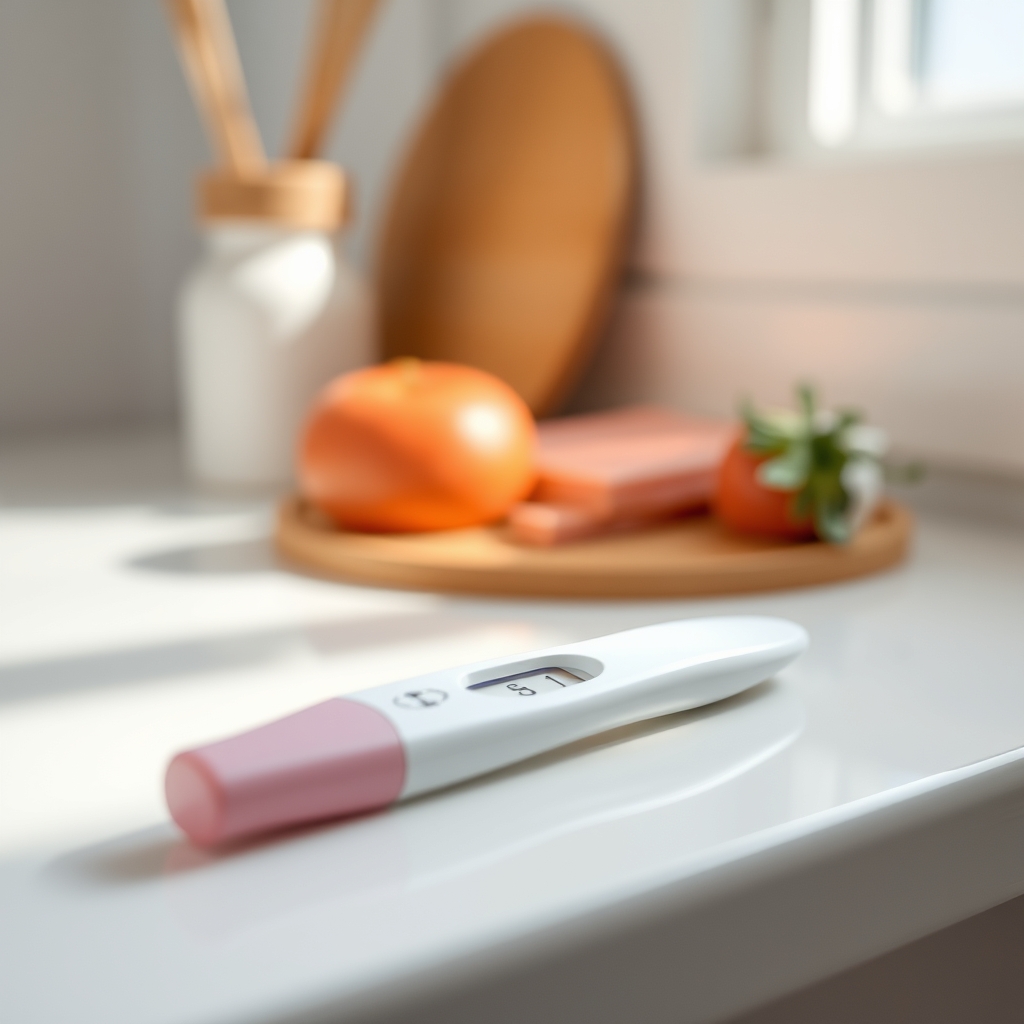
A faint line on a pregnancy test often indicates early pregnancy, even if barely visible. Learn why a faint line appears, what factors influence its darkness, and when to retest for a clearer result. Understand the science behind these tests.
By Shubhra Mishra — a mom of two who turned her own confusion during pregnancy into BumpBites, a global mission to make food choices clear, safe, and stress-free for every expecting mother. 💛
Check whether any food is safe during pregnancy with the BumpBites Food Safety Checker.
Quick take: A faint line on a pregnancy test usually means there is a low level of the pregnancy hormone hCG in your urine. It can be an early positive, a diluted sample, or a false‑positive result. The safest way to know for sure is to retest in a day or two, use a second test, and talk with your provider if you have any concerning symptoms.
It’s 2 a.m., you’ve just woken up with a queasy stomach, and the pregnancy test you bought at the pharmacy shows a barely visible line. Your mind races: “Did I just get pregnant? Or is this a mistake?” You’re not alone. Many people see that faint stripe and wonder whether it’s a real sign of pregnancy, a false alarm, or something else entirely.
In this article we’ll explain exactly what a faint line means, why it shows up, and what you can do next. We’ll walk through how to interpret the result, when to test again, how test sensitivity matters, and what symptoms might (or might not) accompany an early pregnancy. By the end you’ll have a clear, step‑by‑step plan and know which questions to ask your doctor.
We’ll also cover special situations—like after IVF, miscarriage, or when you’re using a digital test—so whatever your circumstance, you’ll find the answers you need.
What does a faint line on a pregnancy test mean?
A faint line appears when the test detects a small amount of human chorionic gonadotropin (hCG) in your urine. hCG is the hormone your placenta produces once a fertilized egg implants, and its levels double roughly every 48‑72 hours in early pregnancy. Most over‑the‑counter tests are designed to show a result when hCG reaches a certain threshold, usually 20–50 mIU/mL. If the hormone is just below that threshold, the test may still produce a very light line.
In practical terms, a faint line can be:
Early pregnancy: The embryo has just implanted and hCG is still low.
Diluted urine: If you’ve been drinking a lot of fluids, the hormone is spread out, making the line weaker.
Technical variation: Some tests are more sensitive than others, and a faint line may appear on a highly sensitive brand even when hCG is barely detectable.
Because the line is present, most manufacturers consider it a positive result—though they often advise confirming with a repeat test.
Lab‑based urine assays can detect hCG at concentrations as low as 5 mIU/mL, whereas most home kits start at 20 mIU/mL. That gap explains why a faint home‑test line can sometimes be the first hint of a pregnancy that a clinic test would catch even earlier.
Faint line on pregnancy test but no symptoms
It’s common to wonder whether a faint line is “real” if you don’t feel any of the classic early‑pregnancy signs—nausea, breast tenderness, or frequent urination. The absence of symptoms doesn’t rule out pregnancy. Hormone levels can vary widely; some people feel symptoms at 5 weeks, others not until 8 weeks.
Anecdotal experience from our community shows many women who first saw a faint line and felt fine, only to later develop a strong positive line and typical symptoms. Others discovered the faint line was a false positive, especially after a recent miscarriage or a recent fertility treatment that can temporarily raise hCG.
If you’re symptom‑free, the best move is to retest in 48 hours with a fresh test and a first‑morning urine sample (when hCG is most concentrated). This will give you a clearer picture.
Emotionally, a faint line can feel like a cliffhanger. Give yourself permission to feel whatever comes up, and remember that a follow‑up test is the most reliable way to move from uncertainty to certainty.
How long after a faint line on pregnancy test can I take another test?
Most experts, including the American College of Obstetricians and Gynecologists (ACOG), recommend waiting at least 24 hours before retesting. This allows any hCG that’s already being produced to rise enough that the next test can show a more definitive result.
For the most accurate follow‑up:
Wait 24–48 hours after the first faint line.
Use a first‑morning urine sample (the first void after waking).
Choose a test with the same or higher sensitivity (look for “10 mIU/mL” on the box).
Follow the instructions exactly—no shaking the test, no extra urine.
If the second test shows a clear line, you can be more confident you’re pregnant. If it’s still faint or turns negative, consider other factors such as dilution, recent hormonal medication, or a possible false positive.
Because hCG follows a circadian rhythm—higher in the morning—testing after a night’s sleep maximizes your chance of catching a faint line that may otherwise be missed later in the day.
Faint line on pregnancy test and then a negative
A scenario where the first test shows a faint line and a second test reads negative can be puzzling. The most common explanations are:
Urine dilution: If the first test was taken after a large fluid intake, the hCG may have been diluted enough to produce a faint line that disappears when a more concentrated sample is used.
Test sensitivity differences: If the second test is less sensitive, it may not pick up the low hCG level.
Transient hCG sources: Certain medical conditions (e.g., recent miscarriage, certain cancers, or fertility medications) can cause a temporary rise in hCG that quickly falls.
When this happens, it’s wise to wait a few more days and test again, or to schedule a blood hCG test with your provider, which can detect much lower hormone levels than urine tests.
Remember that a negative result does not mean you cannot become pregnant later; it simply reflects the hormone level at that moment.
Can a faint line on pregnancy test be a false positive?
Yes, a faint line can be a false positive, though it’s relatively uncommon. False positives occur when the test reacts to substances other than hCG. The most frequent culprits are:
Recent pregnancy loss or miscarriage: Residual hCG can linger for several weeks.
Fertility treatments: Medications containing hCG (e.g., hCG trigger shots) can cause positive results for up to 10 days.
Certain medical conditions: Rare cancers (trophoblastic disease) produce hCG.
Because a faint line is weaker than a full line, the chance of a false positive is slightly higher than with a strong line. If you’re taking fertility medication or have recently experienced a loss, talk to your provider before interpreting the result.
Cross‑reactivity with LH (luteinizing hormone) or certain thyroid hormones can also trigger a faint line on some brands, though modern tests are designed to minimize this interference.
Faint line on pregnancy test and spotting
Spotting (light bleeding) in early pregnancy is called “implantation bleeding” and can happen when the embryo embeds into the uterine lining. It’s usually light pink or brown and lasts a day or two. If you see a faint line and also notice spotting, it could be an early sign of pregnancy—but it could also be unrelated (e.g., hormone fluctuations, cervical irritation).
Most clinicians, including the NHS, advise that spotting alone isn’t a reliable indicator. Combine the visual cue (faint line) with other signs—like breast tenderness or mild cramping—to gauge the likelihood of pregnancy. If spotting is heavy, accompanied by pain, or you suspect a miscarriage, call your provider promptly.
Implantation bleeding typically occurs 6‑12 days after conception, so a faint line that appears around the same time strengthens the case for early pregnancy.
Faint line on pregnancy test and cramping
Light cramping in the first weeks can be normal. The uterus expands, and the body adjusts to hormonal changes. When a faint line appears, mild cramping may simply be the “growing pains” of early implantation.
However, cramping that’s sharp, persistent, or accompanied by bleeding may signal an ectopic pregnancy or a miscarriage. These scenarios are rare but serious, so if you experience any of the following, seek medical attention: pain that radiates to the shoulder, dizziness, or a sudden drop in temperature.
Tracking cramping intensity and timing alongside your test results can give your provider useful clues during a follow‑up appointment.
How common is a faint line on a pregnancy test?
Studies from the CDC and fertility clinics estimate that about 10–15 % of first‑time home users see a faint line that later resolves to a full positive or a negative. The frequency varies by test brand because sensitivity ranges from 10 mIU/mL (very sensitive) to 50 mIU/mL (less sensitive).
In practical terms, most women who see a faint line will either develop a clearer line within a few days or get a negative result on a follow‑up test. The key is to avoid panic and to confirm with a second test or a blood draw.
Across large populations, the predictive value of a faint line rises sharply after 48 hours, which is why most guidelines suggest waiting that long before retesting.
Pregnancy test faint line first response
The first reaction most people have is to stare at the test, hoping the line will become darker. This “first response” is normal, but it’s also a good moment to pause and consider the next steps:
Don’t rush to interpret; give yourself a few minutes.
Write down the date, time, and any symptoms you’re feeling.
Plan a repeat test for the next morning.
By treating the faint line as a prompt for action rather than a definitive answer, you’ll reduce anxiety and increase accuracy.
A quick note‑taking habit—like a short journal entry—helps you spot patterns and gives your provider a clear timeline if you need a clinical visit.
Faint line on pregnancy test at 4 weeks
At four weeks gestation (about two weeks after conception), hCG levels typically range from 5 to 426 mIU/mL, according to the World Health Organization. Most home tests can detect hCG at this stage, but the line may still be faint because the hormone is just climbing above the detection threshold.
If you’re at four weeks and see a faint line, it’s a good sign that implantation has occurred. Continue with prenatal vitamins, avoid smoking and alcohol, and schedule a first‑trimester appointment with your obstetrician.
Because hCG doubles roughly every 48 hours, a faint line at four weeks often becomes a solid line within a day or two, confirming the pregnancy.
Faint line on digital pregnancy test
Digital tests show words like “Pregnant” or “Not Pregnant” instead of lines. However, some digital devices also display a faint “low hCG” indicator when the hormone level is just above the test’s limit. This is essentially the same phenomenon as a faint line on a strip test.
Digital tests are often slightly less sensitive than the most sensitive strip tests, but they reduce user error because they interpret the result for you. If your digital test displays a faint or ambiguous readout, treat it as a positive and confirm with another test or a blood hCG.
Some digital brands now include a “early‑positive” icon that appears when hCG is detected below the standard threshold, offering an extra visual cue for users.
Faint line on pregnancy test after miscarriage
After a miscarriage, residual hCG can linger for up to three weeks. It’s not uncommon for a woman to see a faint line during this period, even though the pregnancy is no longer viable. The line will usually fade as the hormone clears.
If you’re trying to conceive again after a loss, a faint line can be confusing. Your provider can order a quantitative blood hCG to verify that levels are dropping, which is reassuring that the miscarriage is complete.
Tracking hCG levels after miscarriage helps differentiate between a lingering hormone and a new, early pregnancy.
Faint line on pregnancy test and then a positive
Many readers report a progression: faint line on the first test, followed by a darker line on a second test taken 24–48 hours later. This pattern aligns with the natural doubling of hCG in early pregnancy.
When the line becomes clearly visible, you can consider the result a confirmed positive. At that point, start prenatal care, schedule a dating ultrasound, and discuss any concerns with your provider.
Seeing the line darken is often the most reassuring moment for those waiting anxiously; it signals that the embryo is likely developing as expected.
Faint line on pregnancy test with twins
Carrying twins typically results in higher hCG levels earlier in pregnancy because there are two placentas producing the hormone. Paradoxically, a faint line can still appear if the test is taken very early—before the hormone surge.
In twin pregnancies, hCG can double more rapidly, so a faint line that turns bold within 24 hours is a common clue that you might be expecting multiples. An early ultrasound can confirm this.
Higher hCG trends don’t guarantee multiples, but they do raise the index of suspicion and prompt earlier sonographic evaluation.
Faint line on pregnancy test at 5 weeks
By five weeks gestation, hCG levels usually range from 18 to 7,340 mIU/mL. Most home tests will show a strong line by now, but a faint line may still occur if you’re testing later in the day (when urine is more diluted) or if the test brand is less sensitive.
If you’re at five weeks and the line is still faint, retest with a first‑morning sample, or have a quantitative blood test done. This will give you an accurate picture of how the pregnancy is progressing.
Because the window for detecting a faint line narrows after five weeks, a persistent faint line at this stage often warrants a blood test for confirmation.
Faint line on pregnancy test after IVF
In vitro fertilization (IVF) protocols often include a “hCG trigger” shot to mature the eggs. This injection can cause a positive home test as early as 10 days after the trigger, sometimes appearing as a faint line because the hormone level is still low.
Because IVF cycles are closely monitored, your fertility clinic will typically confirm pregnancy with a blood hCG test around 10–14 days post‑transfer. If you see a faint line at home, contact your clinic—they’ll advise whether a blood test is needed or if you can wait for the scheduled check.
Even a faint line after IVF can be a reassuring sign, but your clinic’s protocol will determine the exact timing of the next step.
Even a barely visible line can signal early pregnancy—especially when taken with first‑morning urine.
How to interpret a faint line on a pregnancy test
Interpreting the line correctly is the cornerstone of making confident decisions. Follow these steps:
Check the control line: If the control line is missing, the test is invalid and should be redone.
Identify the test’s sensitivity: Look at the package; a test that reads “10 mIU/mL” is more likely to show a faint line early.
Compare the faint line to the control: If the faint line is lighter but clearly visible, consider it a positive.
Note the timing: A faint line within 48 hours of a missed period is more likely to be a true early positive.
Retest: Use a fresh test after 24–48 hours with first‑morning urine.
When in doubt, a quantitative blood hCG test is the gold standard— it can detect levels as low as 1 mIU/mL and will tell you exactly how fast the hormone is rising.
Remember that home tests are designed for convenience, not for diagnosing complex hormonal scenarios; a lab test provides the definitive answer.
Faint line on pregnancy test and early pregnancy symptoms
Early symptoms such as mild nausea, breast tenderness, or increased urination often appear after hCG reaches about 50 mIU/mL. If you have a faint line and these symptoms, the odds favor a true pregnancy.
Conversely, many women experience a faint line without any symptoms because hCG hasn’t yet peaked. This is why confirming with a repeat test is essential.
Symptom tracking alongside test results creates a clearer picture and can help your provider decide if further evaluation is needed.
Faint line on pregnancy test and pregnancy test sensitivity
Test sensitivity is the lowest hCG concentration a test can detect. Brands like First Response Early Result claim a sensitivity of 10 mIU/mL, while others sit at 25 mIU/mL. The more sensitive the test, the more likely you’ll see a faint line early on.
Below is a quick comparison of common over‑the‑counter brands and their advertised sensitivity levels:
Brand
Sensitivity (mIU/mL)
Typical faint‑line appearance
First Response Early Result
10
Can appear as a faint line as early as 6‑8 days post‑ovulation
Clearblue Rapid
25
Faint line usually shows at 8‑10 days post‑ovulation
EPT Pregnancy Test
20
Faint line may appear around 7‑9 days post‑ovulation
Choosing a test with higher sensitivity increases the chance of catching a pregnancy early, but it also raises the probability of seeing a faint line that later turns negative.
When you read the packaging, look for the phrase “early detection” or “detects hCG as low as X mIU/mL.” That language tells you exactly how early the test could pick up a faint line.
What to do if you get a faint line on a pregnancy test
Here’s a concise action plan:
Stay calm. A faint line is not an emergency.
Check the control line. If it’s missing, discard the test.
Retest in 24–48 hours. Use first‑morning urine and a new test.
Consider test sensitivity. If you used a highly sensitive brand, a faint line may be an early positive.
Track symptoms. Note any nausea, breast changes, or spotting.
Schedule a blood hCG. If you’re uncertain or have risk factors (recent IVF, miscarriage), a blood draw offers definitive answers.
Contact your provider. Especially if you have cramping, bleeding, or other concerning signs.
Following these steps will give you clarity while keeping anxiety to a minimum.
Self‑care during this waiting period—staying hydrated, getting enough rest, and limiting caffeine—can help you feel steadier while you await results.
Start your day with a glass of water and prenatal vitamins while you wait for a clearer test result.
How medications and supplements can affect pregnancy test results
Several prescription and over‑the‑counter products can interfere with the accuracy of home pregnancy tests. Fertility drugs that contain hCG (e.g., Ovidrel, Pregnyl) will cause a positive result for up to 10 days after the injection, even if conception has not occurred.
Hormonal birth control, especially progestin‑only pills, generally does not cause false positives, but they can mask early pregnancy symptoms, leading some users to delay testing. Certain herbal supplements, such as high‑dose chasteberry, have been reported anecdotally to affect hCG readings, though robust data are lacking.
When you’re on any medication or supplement, check the package insert for notes about pregnancy testing, or ask your pharmacist for clarification.
When to consider a quantitative blood hCG test
A quantitative (or “beta”) blood hCG test measures the exact concentration of the hormone in the bloodstream. It can detect levels as low as 1 mIU/mL—far below the threshold of most urine tests. This test is especially useful if you:
Have a faint line that remains ambiguous after two home tests.
Are undergoing fertility treatment and need precise timing.
Experienced a recent miscarriage and want to confirm hormone clearance.
Have symptoms suggestive of an ectopic pregnancy or early loss.
Because the blood level rises predictably in a healthy pregnancy, a single measurement followed by a repeat in 48 hours can confirm whether the pregnancy is progressing normally.
Most labs can provide results within a few hours, and your provider can interpret the trend to guide next steps.
How to track your hCG trends at home
If you prefer to stay on top of your hormone levels without frequent clinic visits, some home‑testing kits now offer a “serial testing” feature. By using the same brand of highly sensitive test each day, you can observe whether the line darkens, stays the same, or fades.
Record the date, time, and line intensity (e.g., faint, medium, dark) in a simple notebook or a phone note. A consistent darkening over 48 hours suggests a viable pregnancy, while a fading line may indicate a declining hCG level that warrants medical evaluation.
While this DIY tracking can be reassuring, it does not replace professional care—always share your observations with your provider.
From our medical team: A faint line most often means early pregnancy, but it can also be caused by diluted urine or a very low hCG level that isn’t yet sustainable. The safest way to confirm is a repeat home test with first‑morning urine, followed by a blood hCG if the result stays ambiguous. If you experience any bleeding, severe cramping, or dizziness, seek care right away.
Myth vs. fact
Myth: A faint line always means you’re pregnant.
Fact: A faint line indicates the test detected some hCG, which could be from an early pregnancy, diluted urine, or a residual hormone after a miscarriage or fertility treatment.
Myth: If the faint line disappears on a second test, the first result was a “false positive.”
Fact: A disappearing line often means the initial hCG level was borderline; it may have been a true early positive that fell below detection because of dilution or timing.
Myth: You can’t get pregnant if you have a faint line and no symptoms.
Fact: Many people feel perfectly fine in the first weeks of pregnancy; symptoms vary widely, and a faint line can still represent a genuine early pregnancy.
Key takeaways
A faint line means low‑level hCG was detected—often an early positive.
Always check that the control line appears; without it the test is invalid.
Retest in 24–48 hours using first‑morning urine for a clearer result.
Higher‑sensitivity tests are more likely to show faint lines early.
If you’re on fertility meds, have had a recent miscarriage, or notice spotting/cramping, contact your provider.
A blood hCG test is the most accurate way to confirm early pregnancy.
Keep a simple log of test dates, times, and any symptoms to share with your healthcare team.
Frequently asked questions
What does a faint line on a pregnancy test mean?
The faint line indicates that a small amount of hCG was found in your urine. It can be an early sign of pregnancy, diluted urine, or a borderline result that needs confirmation.
Can a faint line on a pregnancy test be a false positive?
Yes. Recent fertility treatments, a recent miscarriage, or certain medical conditions can cause a faint positive that isn’t an ongoing pregnancy.
How long after a faint line on pregnancy test can I take another test?
Most experts advise waiting at least 24 hours, preferably 48 hours, and using a first‑morning urine sample for the next test.
What are the chances of a faint line on a pregnancy test being accurate?
When the test is taken early (4–5 weeks gestation) and the control line is present, a faint line is accurate about 70–80 % of the time, especially if you retest and the line darkens.
Can a faint line on a pregnancy test indicate a miscarriage?
A faint line after a confirmed pregnancy could signal a dropping hCG level, which sometimes happens with a miscarriage. However, a faint
Not sure about the label on Faint Line On Pregnancy Test Does It Mean You Re Pregnant products?
Snap the ingredients list and SafeFilter checks every ingredient for your stage — only 3 free scans this month, then you're locked until reset. Unlimited from $7/mo or $50/yr.
When Shubhra Mishra was expecting her first child in 2016, she was overwhelmed by conflicting food advice — one site said yes, another said never. By the time her second baby arrived in 2019, she realized millions of mothers face the same confusion.
That sparked a five-year journey through clinical nutrition papers, cultural diets, and expert conversations — all leading to BumpBites: a calm, compassionate space where science meets everyday motherhood.
Her long-term vision is to build a global community ensuring safe, supported, and free deliveriesfor every mother — because no woman should face pregnancy alone or uninformed. 🌿
🌍 Stand with mothers, shape safer guidance
Join a small circle of experts who review BumpBites articles so expecting parents everywhere can decide with confidence.