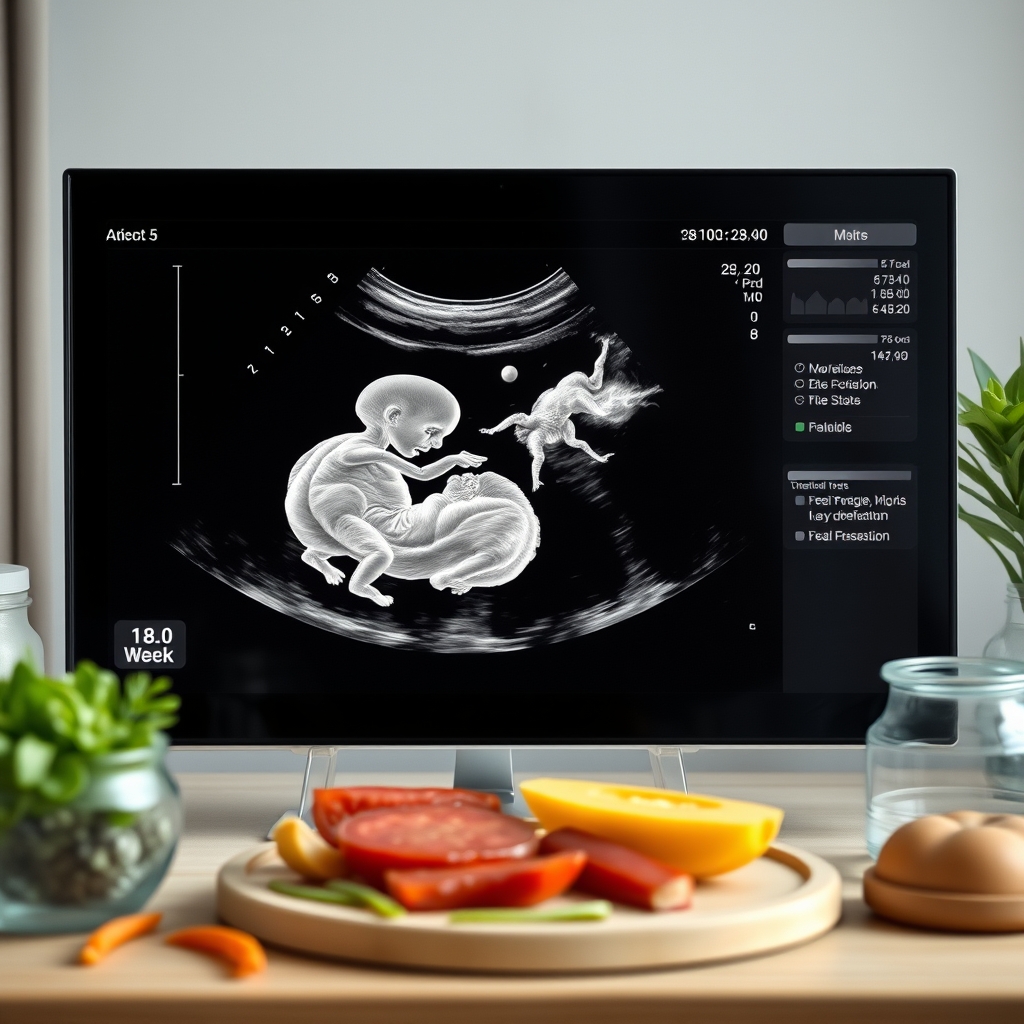
At 18 weeks pregnant, the baby is about 5.5 inches long and weighs around 6.7 ounces. Discover the size, growth milestones, and what to expect at this stage.
By Shubhra Mishra — a mom of two who turned her own confusion during pregnancy into BumpBites, a global mission to make food choices clear, safe, and stress-free for every expecting mother. 💛
Check whether any food is safe during pregnancy with the BumpBites Food Safety Checker.
Quick take: At 18 weeks pregnant, your baby is about the size of a lime—roughly 5½ inches (14 cm) long and weighing around 5 ounces (140 g). Most babies this size are healthy, and you may already feel gentle movements. Ultrasound measurements confirm growth, and key milestones include early hearing and the start of facial feature development.
It’s 2 a.m., you’re curled up on the couch with a half‑finished cup of tea, and a sudden flutter in your belly makes you wonder: “How big is my baby right now?” You’re not alone. Many expecting parents hit a similar moment around the 18‑week mark, when curiosity peaks and the baby’s size becomes a tangible reality.
In this guide we’ll break down exactly how big a 18‑week fetus is, what it looks like, how it compares to everyday objects, and why those numbers matter. You’ll learn what developmental milestones are happening, what you can feel and hear, how ultrasound charts track growth, and when a size that feels “off” might need a professional check‑in.
Whether you’re scanning the latest ultrasound photo, wondering if your baby’s size aligns with your due date, or just need a clear picture to share with family, we’ve gathered the science, the practical tips, and the reassuring facts you need—all in one place.
How big is a baby at 18 weeks pregnant?
By the time you reach the 18‑week point of pregnancy, the fetus has grown from a tiny bean to a recognizable tiny human. The average length from head to heel is about 5½ inches (14 cm), and the weight is roughly 5 ounces (140 g). These measurements are based on large‑scale studies compiled by the American College of Obstetricians and Gynecologists (ACOG) and mirrored in the UK’s National Health Service (NHS) fetal growth charts.
Think of the size as a lime or a small avocado—both fit comfortably in the palm of an adult hand. This visual cue helps many parents grasp the change from earlier weeks, when the baby was closer to the size of a walnut.
It’s also helpful to remember that “average” is a statistical midpoint. Healthy babies can range from 12 cm to 16 cm in length and weigh anywhere from 110 g to 170 g at 18 weeks, depending on genetics, maternal nutrition, and the exact gestational dating.
What is the length of an 18‑week fetus in centimeters?
The crown‑to‑heel measurement, the standard for fetal length, sits at 14 centimeters on average at 18 weeks. This figure comes from the World Health Organization (WHO) growth standards, which track thousands of pregnancies worldwide to establish reliable benchmarks.
For a quick conversion, 14 cm equals about 5½ inches—again, the size of a lime, a small plum, or a round orange. If you’re tracking growth on a chart, your provider will compare this measurement against the 5th and 95th percentile lines to ensure the baby is growing as expected.
Because each fetus develops at its own pace, a slight deviation from the 14‑cm mark isn’t automatically a cause for concern. However, consistent measurements that fall far outside the typical range may prompt your provider to order additional ultrasounds or tests.
18 weeks pregnant baby weight compared to fruit
At 18 weeks, the baby’s weight is about 140 grams (5 ounces). This is roughly the weight of a small lime, a large plum, or a half‑ripe avocado. In the United States, the Food and Drug Administration (FDA) cites a medium lime as weighing around 100 g, making the fetus slightly heavier than the fruit.
Fetal Size (18 weeks)
Common Fruit Comparison
Approximate Weight
Length: 14 cm (5½ in)
Lime (or small avocado)
~140 g (5 oz)
Weight: 140 g (5 oz)
Medium plum
~120–130 g
Length: 14 cm
Half a ripe avocado
~150 g
These comparisons give a tangible sense of the baby’s growth and can be a fun way to involve siblings or partners—“Look, the baby’s the size of our favorite fruit!”
What can an 18‑week fetus hear or see?
By week 18, the auditory system has developed enough that the fetus can start responding to sound. The inner ear’s cochlea is forming, and the brain begins to process vibrations from the outside world. While the baby cannot “hear” in the adult sense, studies reported by the Center for Disease Control and Prevention (CDC) show that a fetus at 18 weeks will react to loud noises—such as a sudden clap or a music beat—by moving its limbs.
Vision is still very limited. The eyes are sealed shut until about 26 weeks, but the retina is beginning to sense light. Experiments with ultrasound have observed that a fetus can turn its head away from a bright light shone on the mother’s abdomen, indicating rudimentary light detection.
These sensory milestones mean you might notice your baby responding to your voice or to music you play softly in the background. Talk to your baby, sing lullabies, and enjoy the early connection—your words are already reaching them.
Developmental milestones at 18 weeks pregnancy
Week 18 marks a busy period of organ and tissue formation. Below is a concise snapshot of what’s happening:
Musculoskeletal: Limb buds are now fully formed; fingers and toes are separated, and tiny nails begin to appear.
Digestive: The liver starts producing bile, and the intestines are busy absorbing nutrients from the amniotic fluid.
Nervous system: Rapid brain development; the spinal cord is fully formed, and the fetus begins to make spontaneous movements.
Cardiovascular: The heart beats at a steady 150–170 bpm, and blood vessels are branching out to supply every new tissue.
Respiratory: The lungs are developing airway branches, though surfactant production will not start until later.
Sensory: As noted, the inner ear is functional enough for sound detection, and the eyes can sense light.
These milestones are reflected in the ultrasound images you’ll see at the 18‑week scan—tiny hands grasping, a clear spinal curve, and a distinct head shape that feels more human each day.
Is 18 weeks baby size normal for my due date?
Every pregnancy follows its own timeline, but most providers use the National Institute for Health and Care Excellence (NICE) guidelines to gauge whether a fetus’s size aligns with the expected gestational age. A baby measuring roughly 14 cm and 140 g at 18 weeks falls comfortably within the 5th–95th percentile range for most populations.
If your ultrasound shows a size that is a few days ahead or behind your estimated due date, it’s usually not a problem. Growth can vary based on factors like maternal weight, nutrition, and even the baby’s activity level. However, a consistent lag of more than two weeks may lead your provider to check for conditions such as intrauterine growth restriction (IUGR) or dating inaccuracies.
When you receive your scan report, look for terms like “appropriate for gestational age (AGA)” or “within normal limits.” Those phrases mean the baby’s size matches the statistical expectations for your calendar week.
How does 18‑week baby size compare to 4 weeks ago?
Four weeks earlier, at around 14 weeks, the fetus was about the size of a lemon—roughly 8 cm long and weighing close to 43 g (1.5 oz). In the span of a month, the baby more than doubles in length and triples in weight.
Here’s a quick side‑by‑side comparison:
Gestational Age
Length (cm)
Weight (g)
Common Fruit Comparison
14 weeks
8 cm (3 in)
43 g (1.5 oz)
Lemon
18 weeks
14 cm (5½ in)
140 g (5 oz)
Lime / Small avocado
The rapid growth reflects the brain’s expansion and the increasing complexity of organ systems. This “growth spurt” is why many parents start feeling the baby’s first movements—known as “quickening”—around this time.
What are the signs of a healthy 18‑week fetus?
Even without an ultrasound, there are several indicators that suggest your baby is thriving at 18 weeks:
Movement: You may begin to feel gentle flutters, especially after meals or when you lie on your side.
Heart Rate: A steady fetal heart rate between 120–160 bpm, detectable with a Doppler device, is a reassuring sign.
Amniotic Fluid: Adequate fluid levels provide cushioning and are visible on ultrasound.
Maternal Well‑Being: Consistent weight gain (about 0.5 kg per week), balanced nutrition, and absence of severe cramping are supportive factors.
Ultrasound Findings: Clear visual of the head, spine, and limbs, with measurements that fall within the normal percentile range.
If you notice any of the following, contact your provider promptly: sudden loss of fetal movement, severe abdominal pain, bleeding, or a fever over 38 °C (100.4 °F).
At 18 weeks, your baby is about the size of a fresh lime—easy to picture and reassuringly small.
Average baby size at 18 weeks gestation
The American Pregnancy Association compiles data from thousands of ultrasounds to give a reliable average: 14 cm (5½ in) in length and 140 g (5 oz) in weight. These figures are used by clinicians worldwide to create growth curves and assess fetal development.
It’s worth noting that “average” does not equal “ideal” for every baby. Genetic factors, maternal health, and lifestyle can shift a baby’s size up or down a few centimeters or grams while still remaining perfectly healthy.
18 week pregnancy baby size chart
Below is a concise chart that many providers hand out during prenatal visits. It aligns fetal measurements with common objects, helping parents visualize growth week by week.
Week
Length (cm)
Weight (g)
Object Comparison
14
8
43
Lemon
16
11
80
Plum
18
14
140
Lime / Small avocado
20
16
300
Banana
Use this chart as a quick reference when you hear your baby’s heartbeat or feel a flutter—it puts the numbers into everyday context.
What size is a 18 week baby in inches?
For those more comfortable with imperial units, the 18‑week fetus measures about 5½ inches from crown to heel. This is roughly the length of a standard lime or a small plum. The weight translates to about 5 ounces, comparable to a handful of grapes.
When discussing measurements with your provider, you’ll often hear both centimeters and inches, especially in the United States where both systems are used in medical documentation.
How much does a baby weigh at 18 weeks?
The typical weight at 18 weeks is 140 grams (5 ounces). This figure aligns with the World Health Organization growth standards and is supported by large‑scale data from the National Institute of Child Health and Human Development (NICHD). Babies can vary by ±30 g and still be considered normal, especially if the growth curve stays within the 5th–95th percentile range.
Weight gain accelerates after this point; by 20 weeks the average baby weighs about 300 g (10 oz), illustrating the rapid development that follows.
18 weeks pregnant baby size vs 20 weeks
Comparing two adjacent weeks highlights the exponential growth pattern. At 18 weeks the fetus is roughly 14 cm (5½ in) and 140 g (5 oz). By 20 weeks, it stretches to about 16 cm (6¼ in) and 300 g (10 oz).
These numbers demonstrate that in just two weeks the baby can gain more than double its weight and add a couple of centimeters in length. This spike is driven by the rapid development of muscle tissue, brain growth, and the accumulation of fat reserves that will later support thermoregulation after birth.
Can I feel my baby at 18 weeks?
Yes—many parents report the first “quickening” between 18 and 22 weeks, especially if it’s a first pregnancy. The movements feel like gentle bubbles, butterflies, or a light tapping. They’re usually more noticeable when you lie on your left side, after a meal, or when you’re relaxed.
If you haven’t felt any movement yet, don’t panic. Factors such as a deep placenta, a smaller uterus, or a later ovulation date can shift the timing. Keep tracking any sensations, and discuss them at your next prenatal visit.
Ultrasound measurements for 18 week fetus
During the anatomy scan around 18–22 weeks, sonographers measure several key parameters:
Head circumference (HC): Gives an idea of brain growth.
Biparietal diameter (BPD): Width of the skull.
Abdominal circumference (AC): Reflects liver and organ size.
Femur length (FL): Indicates bone growth.
These measurements are plotted on growth charts from the International Society of Ultrasound in Obstetrics and Gynecology (ISUOG). If the values fall within the 10th–90th percentile range, the fetus is considered to be growing normally.
Occasionally, a provider will calculate an estimated fetal weight (EFW) using a formula that incorporates HC, AC, and FL. At 18 weeks, the EFW should be close to the 140 g mark, though slight variations are expected.
An 18‑week ultrasound reveals the baby's tiny fingers, head shape, and developing spine.
Tips for monitoring fetal growth and when to consult a provider
While most parents rely on scheduled ultrasounds, there are simple ways to stay aware of your baby’s development between visits:
Track movements: Begin a daily log once you notice quickening. A pattern of at least 10 movements in 2 hours is reassuring.
Watch your weight: Steady, gradual gain (about 0.5 kg per week) supports healthy fetal growth.
Maintain nutrition: Aim for a balanced diet rich in protein, iron, calcium, and omega‑3 fatty acids—key nutrients for rapid organ development.
Stay hydrated: Adequate fluid intake helps maintain amniotic fluid volume, which cushions the baby.
Ask questions at appointments: Bring your ultrasound report, note any concerns about size or movement, and request clarification on percentile ranges.
If you notice any of the red‑flag symptoms listed below, or if your movement log suddenly drops, contact your provider right away.
From our medical team: “At 18 weeks, a baby’s growth is rapid but generally predictable. If your ultrasound measurements are within the normal range and you’re feeling regular movements, you’re on track. Trust your instincts—any sudden change in movement or new pain deserves a prompt call to your care team.”
Myth vs. fact
Myth: “If my baby is the size of a lime, it must be too small to be healthy.”
Fact: A 14‑cm, 140‑g baby is the average size at 18 weeks and is perfectly normal. Size variations within a few centimeters are common and usually harmless.
Myth: “I can’t feel my baby until the third trimester, so nothing is happening now.”
Fact: Many parents feel the first movements (quickening) between 18 and 22 weeks. Even if you haven’t felt it yet, the baby is actively developing organs, hearing sounds, and gaining weight.
Myth: “If the baby’s weight is a little off, the pregnancy is doomed.”
Fact: Small deviations in weight are often just normal variations. Only persistent, significant discrepancies trigger further evaluation.
Key takeaways
At 18 weeks the average fetal length is 14 cm (5½ in) and weight is 140 g (5 oz)—about the size of a lime.
Key milestones include early hearing ability, formation of nails, and rapid brain and muscle growth.
Ultrasound measurements (HC, BPD, AC, FL) confirm growth; values within the 5th–95th percentile are reassuring.
First movements (quickening) often start between 18–22 weeks; track them daily.
Variations in size are normal; discuss any concerns with your provider, especially if measurements fall far outside percentile ranges.
Maintain balanced nutrition, steady weight gain, and hydration to support healthy growth.
Frequently asked questions
How big is a baby at 18 weeks?
At 18 weeks, the baby is about 14 cm (5½ inches) long and weighs roughly 140 g (5 ounces), comparable to a lime or small avocado.
What does a baby look like at 18 weeks?
The baby has a distinct head shape, tiny fingers and toes with nails beginning to form, and a curved spine; you can see these details on an anatomy ultrasound.
Can you feel your baby move at 18 weeks?
Yes—many parents experience the first “quickening” between 18 and 22 weeks, feeling gentle flutters or bubbles, especially when lying on the left side.
What are the baby's development milestones at 18 weeks?
Key milestones include early auditory development, formation of nails, limb separation, liver bile production, and the beginning of spontaneous movements.
Is it normal for a baby to be this size at 18 weeks?
Yes—average measurements (14 cm, 140 g) fall within the normal 5th–95th percentile range; slight variations are common and usually harmless.
How much does a baby weigh at 18 weeks?
The typical weight is about 140 grams (5 ounces), similar to a small lime or half a ripe avocado.
When to call your doctor
If you notice any of the following, contact your healthcare provider promptly:
Sudden decrease in fetal movements or no movement after 24 weeks.
Severe abdominal pain, cramping, or pressure.
Bleeding, spotting, or fluid discharge.
Fever over 38 °C (100.4 °F) without a known cause.
Persistent swelling of hands, feet, or face.
This article is for informational purposes only and does not replace personalized medical advice. Always consult your obstetrician or midwife with specific concerns.
References
American College of Obstetricians and Gynecologists (ACOG). “Ultrasound in Pregnancy.” Clinical guidance, 2023.
National Health Service (NHS). “Fetal development: week by week.” UK health guidance, 2022.
World Health Organization (WHO). “Fetal growth standards.” Global health data, 2021.
Centers for Disease Control and Prevention (CDC). “Fetal development and hearing.” Public health resources, 2022.
National Institute of Child Health and Human Development (NICHD). “Fetal growth charts.” Research publication, 2020.
International Society of Ultrasound in Obstetrics and Gynecology (ISUOG). “Standardized measurements for fetal anatomy scan.” Clinical practice guidelines, 2023.
American Pregnancy Association. “Average fetal size by week.” Educational resource, 2022.
National Institute for Health and Care Excellence (NICE). “Antenatal care guidelines.” UK clinical recommendations, 2022.
Mayo Clinic. “Quickening: First fetal movements.” Patient information, 2023.
Food and Drug Administration (FDA). “Fruit weight reference.” Food composition data, 2021.
Not sure about the label on 18 Weeks Pregnant Baby Size products?
Snap the ingredients list and SafeFilter checks every ingredient for your stage — only 3 free scans this month, then you're locked until reset. Unlimited from $7/mo or $50/yr.
When Shubhra Mishra was expecting her first child in 2016, she was overwhelmed by conflicting food advice — one site said yes, another said never. By the time her second baby arrived in 2019, she realized millions of mothers face the same confusion.
That sparked a five-year journey through clinical nutrition papers, cultural diets, and expert conversations — all leading to BumpBites: a calm, compassionate space where science meets everyday motherhood.
Her long-term vision is to build a global community ensuring safe, supported, and free deliveriesfor every mother — because no woman should face pregnancy alone or uninformed. 🌿
🌍 Stand with mothers, shape safer guidance
Join a small circle of experts who review BumpBites articles so expecting parents everywhere can decide with confidence.