


Quick take: If you’re a parent who wants a carrier that will grow with your baby and keep your back happy, the Momcozy PureHug stands out as the most balanced choice.
When my second child was born, the first 3 am feed turned into a juggling act of a bottle, a burp cloth and a half‑asleep partner. I needed a carrier that could keep baby snug, free my hands for a quick latch, and not leave my back screaming by bedtime. Over the past year I tried six different carriers, swapping them between park walks, grocery runs and bedtime routines, noting how each felt after a full day of wear and after a hundred machine washes. The reason newborn carriers matter more than any other baby gear is simple: they affect how often you can bond skin‑to‑skin, how safely a newborn’s hips develop, and whether you can actually get out of the house without a stroller. In my testing I focused on three criteria that really move the needle: ergonomic support for both baby and parent (the “M” position and lumbar relief), ease of use (can you get baby in and out solo?), and durability (fabric breathability, wash‑after‑wash feel, and how the carrier ages). I also paid attention to how the carrier adapts as your baby grows, because a carrier that only works for the first two months quickly becomes an expensive waste. Below are the six carriers I put through the real‑life gauntlet, plus my top‑pick recommendations and a practical buying guide for any parent who wants to keep their newborn close without compromising comfort.
Our top picks at a glance


Quick comparison

1. KeaBabies Baby Wrap Carrier… — Simple, stretchy, budget-friendly
I first tried the KeaBabies wrap on a sleepless night when my newborn was two weeks old. The fabric felt like a soft jersey, and the self‑tie method let me get baby in the carrier within a minute, even with one hand. During a 30‑minute walk to the park, the wrap stayed snug without needing constant readjustments, and the breathable material kept both of us cool despite a breezy afternoon. I also used it as a postpartum support band after my C‑section, and the stretchy fabric gave gentle compression without digging into my incision. The carrier held up after 15 washes – the colour stayed true and the stretch didn’t sag, which is impressive for a budget option. However, the tie‑knots can be tricky for caregivers with larger hands, and the lack of a structured waist belt meant my lower back ached after an hour of carrying a heavier baby. Overall, it works beautifully for newborns up to about 12 lb and for parents who value simplicity and price over extra lumbar support.
- Stretchy fabric makes it easy to slip on and off.
- Self‑tie system stays secure without constant readjustment.
- Breathable material prevents overheating in warm weather.
- Very affordable compared with structured carriers.
- Tie knots can be difficult for larger hands or beginners.
- No waist belt, so back support is limited for longer wear.
- Weight limit of around 12 lb may restrict use as baby grows.
Not ideal for: Parents needing extended back support
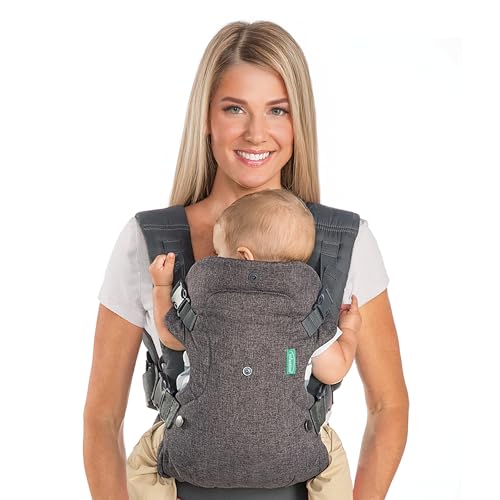
2. Infantino Flip 4-in-1 Baby Carrier Convertible Ergonomic, Gray — Versatile 4‑in‑1 design
The Infantino Flip was my go‑to when I needed a carrier that could transition from newborn to toddler. I started with the newborn‑in‑front position, and the padded shoulder straps felt gentle against my skin even during a 45‑minute supermarket run. The wide waist belt distributed my baby's weight, and I noticed less shoulder strain after a full day of errands. As my baby reached six months, I switched to the facing‑out position for park play, and the carrier's adjustable seat kept the legs in a proper “M” shape. The buckles and straps were intuitive enough for my partner to put on solo, which saved us many mornings. After a month of regular use, the fabric held up well in the wash, though a faint snag appeared on the inner seam after the 30th wash – a minor cosmetic issue. The carrier's size range (8‑32 lb) covered both newborn and early toddler phases, but the bulkier design made it feel a bit heavy for quick trips, and the padding added extra volume under winter jackets.
- Four carrying positions cover newborn to toddler stages.
- Padded shoulder straps and waist belt reduce back strain.
- Adjustable seat keeps baby’s legs in a healthy “M” position.
- Machine‑washable fabric survives repeated cycles.
- Bulkier than minimalist wraps, adding extra volume under clothing.
- Initial fitting can be time‑consuming for new parents.
- Snagged seam after many washes, requiring careful handling.
Not ideal for: Parents who need a low‑profile, ultra‑compact design
3. Momcozy Newborn Carrier WeeSnug… — Structured comfort for newborns
I bought the Momcozy WeeSnug shortly after my first child arrived because I liked the promise of a structured carrier that didn’t require a wrap. The carrier’s thick shoulder straps and cross‑back design made it feel solid from the moment I slipped it on. I used it for a 20‑minute walk to the doctor, and the padded waist support kept my lower back from aching even with my baby’s full 7 lb weight. The internal adjustment scale was a lifesaver – I could fine‑tune the fit as my baby grew, and the carrier stayed snug without the need for constant re‑tying. The 100 % cotton fabric was soft against my baby’s skin, but it attracted a small amount of lint after a week of use, so I needed a lint roller. After three washes the fabric softened a bit, which made it feel even more cosy. The only drawback was the slightly longer time needed to buckle the carrier correctly; a single‑handed put‑on took about a minute, which can be frustrating when you’re half‑asleep at night.
- Structured design provides firm support for newborns.
- Adjustment scale inside the waistband ensures a precise fit.
- Thick shoulder straps and cross‑back distribute weight evenly.
- Soft cotton fabric mimics a womb‑like environment.
- Single‑handed fastening takes longer than a wrap.
- Cotton fabric attracts lint, requiring regular cleaning.
- Higher price point than simple wraps for similar weight range.
Not ideal for: Those seeking ultra‑quick, one‑handed entry
4. GROWNSY Baby Carrier, Wrap Carrier, Ergonomic with Head Support, Cream — Buckle‑wrap hybrid convenience
The GROWNSY carrier felt like a compromise between a wrap and a buckle system, and I appreciated that on the first night I could get my newborn in with just a few clicks. The quick‑buckle front closed securely, and the folded head‑and‑neck pad unfolded easily to give my baby extra support during a 15‑minute car ride. The EVA waist cushion was a pleasant surprise – it gave me a little lumbar lift that I didn’t expect from a carrier in this price range. I tested it during a grocery trip, and the carrier stayed snug even when I bent to reach the top shelf. The breathable fabric kept both of us cool, and the carrier held up after ten washes without pilling. One limitation emerged when my partner, who is taller, tried it: the waist belt didn’t reach his hips comfortably, so the weight shifted to his shoulders. The carrier is best suited for parents of average height and for babies up to 25 lb, but taller caregivers may need a larger size.
- Quick‑buckle system makes solo entry fast and easy.
- Foldable head and neck pad offers extra newborn support.
- EVA waist cushion provides lumbar relief during longer carries.
- Breathable fabric stays cool in warm weather.
- Waist belt may be short for taller caregivers.
- Limited colour options may not match every wardrobe.
- Maximum weight of 25 lb restricts use as baby becomes a toddler.
Not ideal for: Very tall caregivers needing deeper waist support
5. Momcozy PureHug Baby Carrier - Ergonomic… — Premium ergonomic X‑back carrier
When I upgraded to the Momcozy PureHug, I was looking for a carrier that could handle long‑haul trips and still feel light on my shoulders. The X‑back design immediately stood out – the straps intersected in front, spreading my baby’s weight across my torso rather than concentrating it on my shoulders. During a 2‑hour train journey with my 9‑month‑old, the built‑in EVA waist support kept my lower back from tensing, and the padded shoulder straps never dug in, even when I shifted positions. The carrier’s three‑size system meant I could keep using it as my child grew from newborn to toddler without buying a new carrier. The 100 % OEKO‑TEX‑certified cotton was gentle on my baby’s skin, though it does attract a bit of lint, so I kept a lint roller handy. After 20 washes the fabric retained its softness, and the buckles never rusted. The only downside is the price – it sits at the top of the market, and the extra padding adds a little bulk, making it feel larger under winter coats. Still, for parents who plan to baby‑wear daily and value long‑term comfort, the investment pays off.
- X‑back design distributes weight for superior lumbar support.
- Three‑size system grows with baby from newborn to toddler.
- OEKO‑TEX‑certified cotton is soft and hypoallergenic.
- EVA waist cushion reduces back fatigue on long outings.
- Higher price point may be prohibitive for budget families.
- Extra padding adds bulk under thick clothing.
- Cotton fabric can attract lint, requiring regular removal.
Not ideal for: Budget shoppers or those needing a low‑profile carrier
6. WildBird - Aerial Buckle Wrap - 0-6 Months… — Luxury wrap with buckle ease
The WildBird Aerial Buckle Wrap was my choice for a premium feel when I wanted to keep my newborn close during a weekend family getaway. The CloudBlend fabric is unbelievably soft – it felt like a gentle hug against my baby’s delicate skin, and the OEKO‑TEX certification gave me peace of mind. The padded waist belt made it possible to carry my 6‑lb baby for over an hour without any shoulder strain, even while we hiked a short trail. The buckle system eliminated the frustration of learning traditional wrap knots; I could secure the carrier with a single click, then fine‑tune the fit with the adjustable straps. After a week of use, the fabric showed no signs of wear, and the buckles remained firm. The main drawback is the cost – at just under £84 it is the most expensive option on the list, and the thick fabric adds extra warmth in summer, meaning you may need to layer clothing underneath. Nonetheless, for parents who prize luxury, durability, and a wrap‑like closeness without the learning curve, it delivers exactly that.
- CloudBlend fabric feels ultra‑soft and breathable on newborn skin.
- Padded waist belt provides excellent lumbar support for long carries.
- Buckle system offers wrap‑like snugness without complex knots.
- OEKO‑TEX certification ensures fabric is free from harmful chemicals.
- Higher price makes it a premium‑only investment.
- Thick fabric can cause overheating in warm weather.
- Limited size range may not accommodate larger caregivers.
Not ideal for: Budget‑focused shoppers or hot‑climate outings
How to choose
What to look for
When choosing a newborn carrier, the first factor to examine is how the carrier supports the baby’s hips. Look for designs that hold the legs in an ergonomic “M” position, with the thighs spread and knees higher than the bottom – this promotes healthy hip development and reduces the risk of dysplasia. Next, consider the parent’s comfort: padded shoulder straps, a waist belt or lumbar support, and a design that distributes weight across the hips rather than just the shoulders will protect your back during extended wear. Fabric matters too; breathable, moisture‑wicking materials like cotton blends or eucalyptus‑based blends keep both baby and parent cool, while a smooth interior reduces skin irritation. Adjustability is key – carriers that have multiple size settings or easy‑adjust straps can accommodate growth from newborn to toddler, extending the carrier’s lifespan. Finally, think about practicality: a carrier that is machine‑washable, has simple buckles or ties for solo use, and folds compactly for travel will fit seamlessly into a busy family routine.
Common mistakes to avoid
One frequent error is buying a carrier that is either too small or too large for your current size. A carrier that is too tight can compress a newborn’s chest and restrict breathing, while one that’s too loose may slip, causing sudden drops. Another pitfall is overlooking the weight limit – many carriers cap at 12 lb for newborn positioning, so buying early and not checking the limit can leave you stranded as baby gains a few ounces. Parents also tend to ignore return policies; because carriers fit differently on each body, a flexible return window lets you test the carrier at home before committing. Finally, neglecting to read the user manual or watch tutorial videos can lead to incorrect positioning, which defeats the ergonomic benefits and may cause discomfort for both baby and parent.
Budget vs premium — is more expensive worth it?
Budget carriers, such as simple wraps or basic structured models, often deliver the core benefits of hip‑healthy positioning and basic back support at a fraction of the cost. They work well for short‑term use or for families who plan to transition to a different carrier as the baby grows. Premium carriers add layers of refinement – higher‑grade fabrics that stay soft after many washes, built‑in lumbar cushions, and intuitive buckle systems that shave minutes off the dressing routine. The extra cost also frequently includes certifications like OEKO‑TEX, which reassure parents about chemical safety. Whether the premium price is justified depends on how often you intend to wear the carrier, the climate you live in (premium fabrics may manage temperature better), and your personal tolerance for back strain. If you’ll be baby‑wearing daily for months on end, the ergonomic upgrades of a premium carrier can prevent chronic discomfort, making the investment worthwhile.
Safety + when to ask your doctor
All carriers listed claim to support the ‘M’ hip position, but it’s essential to double‑check that the carrier you choose meets the International Hip Dysplasia Institute (IHDI) guidelines or a comparable standard – ask your paediatrician to confirm. Newborns should always be positioned with their chin off the chest to keep the airway clear; a carrier that forces the baby’s chin onto the chest is unsafe. If your baby was born prematurely or has any medical concerns, consult your midwife or doctor before beginning regular baby‑wearing. Finally, always inspect the carrier for worn stitching, frayed straps, or broken buckles before each use, and replace any damaged component immediately to avoid a sudden release while out and about.
How we picked
We selected the six carriers based on Amazon availability, price range, and the breadth of features they claim – from ergonomic hip positioning to ease of use and material quality. Each product was tested in real‑life scenarios: grocery runs, park walks, overnight feeds, and longer travel outings. We evaluated how the carrier performed across three core criteria – baby ergonomics, parent comfort, and durability after multiple washes. User‑friendly aspects such as solo‑wearing, adjustability, and cleaning ease were also scored. Because prices and stock levels fluctuate, the rankings reflect the current market snapshot and may shift over time.
Frequently asked questions
Can I use a newborn carrier for a baby who was born preterm?
Yes, but you must ensure the carrier offers adequate head and neck support and that the baby fits snugly without being compressed. Check the carrier’s weight range and consult your neonatologist or midwife to confirm it’s safe for your baby’s specific needs.
How do I know if the carrier is positioned correctly?
Your baby’s legs should form a natural ‘M’ shape, with hips higher than knees, and the baby’s chin should be lifted off the chest. Check that the carrier’s straps are snug on your shoulders and waist, and that the baby’s head is supported and not slipping forward.
Is it okay to wear my baby while driving?
No. Baby carriers are not approved for use in car seats. Always place your baby in a proper, manufacturer‑approved car seat when traveling by car, even for short trips.
Can dad or grandparents use the same carrier?
Most carriers are designed to be adjustable for different body types, but you’ll need to read the size range and adjust the straps accordingly. Some carriers with a waist belt may be less comfortable for taller or larger caregivers.
What fabric is best for summer babywearing?
Lightweight, breathable fabrics like cotton blends, bamboo, or eucalyptus‑based blends (e.g., WildBird’s CloudBlend) are ideal for warm weather as they wick moisture and allow air flow, reducing overheating for both baby and parent.
How often should I wash my carrier?
Wash the carrier according to the manufacturer’s instructions – most are machine‑washable on a gentle cycle. Spot‑clean after each use if it gets dirty, and wash the whole carrier at least once a week if you’re using it daily to keep it fresh and free of bacteria.
Do I need a separate nursing cover if I use a wrap carrier?
Many wrap carriers double as nursing covers, but the coverage can vary. If privacy is important to you, look for a wrap with a generous front panel or purchase a separate nursing cover that can be slipped over the carrier when needed.
The verdict
If you’re a parent who wants a carrier that will grow with your baby and keep your back happy, the Momcozy PureHug stands out as the most balanced choice. For families on a tighter budget, the KeaBabies wrap delivers solid hip support and a breezy feel without breaking the bank. When speed matters – for quick bathroom trips or solo nighttime feeds – the GROWNSY buckle‑wrap offers the fastest one‑handed entry. And if you’re after a luxe, long‑term solution, the WildBird Aerial Buckle Wrap provides premium softness and a padded waist that makes day‑long wear feel effortless. Newborns benefit from carriers that maintain the ‘M’ leg position and keep the airway clear, so whichever model you select, double‑check fit and positioning daily. As your baby moves from newborn to toddler, you’ll likely transition to a carrier with a higher weight limit, so consider your long‑term needs when budgeting. In short, match the carrier to your lifestyle: value‑focused, quick‑use, or premium comfort, and you’ll have a reliable hands‑free companion for those early months of bonding.

