


Quick take: If you’re standing in the pacifier aisle feeling overwhelmed, here’s my honest advice: start with the Philips Avent Soothie (0-3 months).
The first time my daughter clamped down on a pacifier at 3am, I nearly cried with relief. Not because it magically stopped the crying — it didn’t — but because it gave me something to do while I waited for the next feed. That tiny silicone nipple became a lifeline in those early weeks: a way to soothe without overfeeding, a tool to buy five extra minutes between nappy changes, and, let’s be honest, a sanity-saver when the rocking and shushing just weren’t cutting it. But not all pacifiers are created equal. I’ve tested dozens across two babies, from hospital handouts to the ones that live in every pocket of my nappy bag. What I’ve learned? The right one can mean the difference between a settled baby and a 45-minute battle at bedtime. The wrong one? A sticky, dropped, or rejected lump that sends you back to square one. Here’s what actually matters when choosing: first, acceptance — will your baby even take it? (Some are fussy; others slide in like they were made for your child.) Second, safety and hygiene — one-piece designs, medical-grade materials, and easy sterilisation become non-negotiable when you’re boiling these things daily. Third, skin comfort — those early weeks bring enough irritation without a rigid shield pressing into chubby cheeks. And finally, longevity — because if you’re going to invest in a habit, it should last beyond the newborn phase. I’ve put six of the most popular pacifiers through real-life testing: the 3am feeds, the car-seat drops, the “I forgot to pack one” panic moments. These are the ones that survived the nappy bag, the steriliser, and the occasional floor of a motorway services. No hype, no jargon — just what worked, what didn’t, and which one might actually help your baby (and you) get a little more rest.
Our top picks at a glance


Quick comparison


1. Philips Avent Soothie Baby Pacifiers… — The hospital handout you’ll keep
I first met the Philips Avent Soothie in the hospital, where it was handed to me like a rite of passage. That first night, my son latched onto it immediately — no fuss, no rejection, just a quiet suck that bought me 20 minutes of peace. The one-piece design is a game-changer for hygiene: no crevices for milk to hide in, and it survives daily boiling without losing shape. I’ve dropped these on the floor more times than I can count, and a quick rinse under hot water is all it takes to feel safe using them again. The texture is soft but firm enough to withstand newborn gums, and the symmetrical shape means there’s no “right way up” — a blessing when you’re half-asleep at 3am. My only gripe? The size is strictly for 0-3 months, so you’ll need to upgrade sooner than you’d like. But for those early weeks, it’s the most reliable pacifier I’ve used. It’s not flashy, but it does the job — and sometimes, that’s all you need.
- One-piece design makes cleaning effortless and hygienic
- Accepted by both my babies without fuss
- Durable enough for hospital-level sterilisation
- Symmetrical shape means no wrong way to insert
- Only suitable for 0-3 months — short lifespan
- Basic design lacks features like glow-in-the-dark
- Can be tricky to keep in a wriggly baby’s mouth
Not ideal for: Parents wanting long-term use
2. Philips Avent Soothie Baby Pacifiers… — Same trust, prettier colours
This is the exact same Soothie as the green version, just in lilac and pink. If you’re someone who likes a bit of colour coordination in your baby gear, this is a nice touch — but don’t expect any functional differences. It’s the same one-piece silicone, the same hospital-grade durability, and the same 0-3 month size limit. I used these interchangeably with the green ones, and my daughter didn’t seem to notice the difference. The only real perk here is aesthetics, which might matter if you’re gifting or just prefer a softer palette. That said, the price is nearly identical, so if you’re not fussed about colour, the green pack is just as good. For me, the choice came down to which one was in stock when I needed a refill. It’s a solid pacifier, but the colour won’t make or break your experience.
- Same trusted Soothie design and durability
- Soft lilac and pink colours for a gentler look
- One-piece silicone for easy cleaning
- Accepted by newborns without fuss
- No functional upgrade over the green version
- Still limited to 0-3 months
- Colour may not appeal to all parents
Not ideal for: Those prioritising function over aesthetics
3. Philips Avent Ultra Soft Pacifiers - Orthodontic Design… — The gentle giant for sensitive skin
The Philips Avent Ultra Soft was a revelation for my second baby, who developed red marks from the rigid shields of other pacifiers. The flexible, curved shield moulds to her face, reducing pressure on her cheeks and leaving no indentations after use. The orthodontic nipple is noticeably softer than the Soothie, and the textured surface seems to encourage a better latch — my daughter took to it immediately, even when she’d rejected others. The included sterilising cases are a brilliant touch: they’re compact enough to toss in the nappy bag, and the vented design means the pacifiers dry quickly. I also love that the materials are 80% plant-based, which feels like a small win for the planet. The only downside? The shield is larger than the Soothie, which can make it a bit bulky for tiny newborns. It’s also pricier, but if your baby has sensitive skin or you’re eco-conscious, it’s worth the investment. I wish I’d had these for my first baby — they’ve saved us from so many red-faced meltdowns.
- Flexible shield reduces skin irritation and marks
- Orthodontic nipple is gentle on gums and teeth
- Included sterilising cases make cleaning convenient
- 80% plant-based materials for eco-conscious parents
- Larger shield can feel bulky for newborns
- More expensive than basic models
- Nipple may wear out faster with heavy use
Not ideal for: Parents on a tight budget
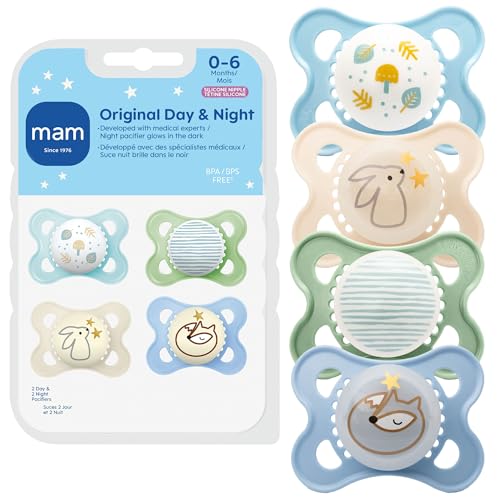
4. MAM Original Baby Pacifiers 0-6 Months, Glows in The Dark, 4 Pack — The nighttime lifesaver
The MAM Original pacifiers became a staple in our house for one reason: they glow in the dark. After the third time I fumbled around the cot at 2am trying to find a dropped pacifier, I ordered these, and they’ve been a game-changer. The glow is subtle but bright enough to spot under the cot or in a dark room, which has saved me countless trips to the kitchen for a torch. The nipple is thin and breast-like, which my son took to immediately, and the symmetrical shape means no right-side-up confusion. The shield is curved and breathable, with little dimples that prevent irritation — a feature I didn’t realise I needed until I saw the red marks from other pacifiers. The only downside is the two-piece design, which means more nooks for bacteria to hide. You have to disassemble them for thorough cleaning, which is a bit of a faff when you’re exhausted. But for the convenience of the glow feature, I’m willing to put up with it. If you’re a parent who’s tired of midnight scavenger hunts, these are worth every penny.
- Glow-in-the-dark feature is a nighttime lifesaver
- Thin, breast-like nipple for easy acceptance
- Breathable shield reduces skin irritation
- Affordable price for a quality pacifier
- Two-piece design requires more thorough cleaning
- Nipple can wear out faster than one-piece models
- Glow fades over time with frequent washing
Not ideal for: Those who prefer one-piece designs
5. Philips Avent Ultra Soft Pacifiers - Orthodontic Design… — The eco-friendly upgrade
This is the same Ultra Soft pacifier as the other Philips Avent model, but with one key difference: it’s made from 80% plant-based materials. If sustainability is a priority for you, this is the pacifier to choose. The performance is identical to the other Ultra Soft — the flexible shield, the orthodontic nipple, the included sterilising cases — but knowing that the materials are more eco-friendly gives me peace of mind. My daughter took to it just as easily as the other version, and the shield hasn’t left any marks on her sensitive skin. The only reason I’d hesitate to recommend this over the other Ultra Soft is the price: it’s a few pounds more, which might not be worth it if you’re not fussed about sustainability. But if you’re trying to reduce your environmental footprint, this is a small but meaningful way to do it. The plant-based materials don’t compromise on durability or safety, and the pacifier holds up just as well in the steriliser. For eco-conscious parents, it’s a no-brainer.
- 80% plant-based materials for sustainability
- Same gentle shield and orthodontic nipple as other Ultra Soft models
- Included sterilising cases for convenience
- Durable and safe for frequent sterilisation
- More expensive than non-eco alternatives
- Larger shield may not suit newborns
- Limited colour options compared to other models
Not ideal for: Budget-focused buyers
6. Philips Avent Soothie Baby Pacifiers… — The Soothie for older babies
This is the Philips Avent Soothie, but sized for babies 3-18 months. I’ll be honest: I didn’t reach for this one often. By the time my babies were old enough to use it, they’d either outgrown pacifiers or preferred the orthodontic shapes of other models. That said, if your baby is a Soothie fan and you want to extend its lifespan, this is a solid option. The one-piece design is just as durable and easy to clean as the newborn version, and the larger size is better suited to older babies who might accidentally swallow smaller pacifiers. The symmetrical nipple is familiar to Soothie users, so there’s no adjustment period. But I found that my babies preferred the Ultra Soft or MAM models by this age, as the orthodontic shapes seemed to suit their developing mouths better. If you’re already using the 0-3 month Soothie and want to stick with it, this is a good upgrade. Otherwise, I’d recommend trying a different shape for older babies. It’s not a bad pacifier, but it’s not the one I’d choose for this age group.
- One-piece design for easy cleaning and hygiene
- Durable and safe for older babies
- Familiar shape for Soothie users
- Larger size reduces choking risk
- Less popular with babies who prefer orthodontic shapes
- Limited appeal for babies over 6 months
- Basic design lacks features like glow-in-the-dark
Not ideal for: Babies who prefer orthodontic shapes
How to choose
What to look for
Choosing a pacifier isn’t just about picking the cutest colour or the brand your friend recommended. The right one can make a real difference in your baby’s comfort — and your sanity. Here’s what to prioritise: First, materials. Medical-grade silicone is the gold standard: it’s durable, easy to clean, and free from harmful chemicals like BPA. Latex is softer but can degrade faster and may cause allergies, so I’d avoid it unless your paediatrician suggests otherwise. Second, design. One-piece pacifiers are the safest and most hygienic, as they have no crevices for bacteria to hide. Two-piece designs can be trickier to clean, but some parents swear by them for their flexibility. Third, shape. Newborns often prefer symmetrical, round nipples like the Soothie, which mimic the breast and feel natural in their mouths. Older babies may do better with orthodontic shapes, which are flatter and designed to support developing teeth and gums. Fourth, shield comfort. A rigid shield can press into your baby’s cheeks, leaving red marks or irritation. Look for flexible, curved shields that follow the contours of their face. Finally, size. Pacifiers are usually sized by age, and using the wrong one can be uncomfortable or even unsafe. A newborn won’t be able to keep a 6-month pacifier in their mouth, and an older baby might choke on a tiny one. Always check the age guidelines and replace pacifiers as your baby grows. Other features, like glow-in-the-dark or sterilising cases, are nice to have but not essential. Focus on what will make your baby comfortable and your life easier — not what looks the fanciest.
Common mistakes to avoid
Even the best pacifier won’t work if you make these common mistakes. First, buying too early. Some parents stock up on pacifiers before their baby is born, only to find their little one rejects every single one. Babies develop preferences quickly, so it’s better to wait until you know what they like. Start with a small pack of a trusted brand, like the Philips Avent Soothie, and see how your baby responds. Second, ignoring hygiene. Pacifiers go through a lot — floors, car seats, nappy bags — and they need to be cleaned regularly. Boiling or sterilising them daily is a must, especially in the early weeks when your baby’s immune system is still developing. One-piece designs are easier to clean, but even those need attention. Third, using the wrong size. A pacifier that’s too small can be a choking hazard, while one that’s too large won’t stay in your baby’s mouth. Always check the age guidelines and replace pacifiers as your baby grows. Fourth, not having backups. Pacifiers get lost, dropped, or chewed beyond recognition. Always have at least two or three on hand, and keep one in the nappy bag, one in the car, and one by the cot. Fifth, forcing it. If your baby rejects a pacifier, don’t push it. Some babies simply don’t like them, and that’s okay. Trying to force it can create more stress for both of you. Finally, not checking for wear. Pacifiers degrade over time, especially with frequent sterilisation. Replace them every 4-6 weeks, or sooner if you notice cracks, tears, or discolouration. A damaged pacifier can be a choking hazard or harbour bacteria.
Budget vs premium — is more expensive worth it?
When it comes to pacifiers, price doesn’t always equal performance. The £10 Philips Avent Soothie is just as effective as the £14 Ultra Soft, and the £11 MAM Original offers features like glow-in-the-dark that you won’t find in pricier models. That said, there are times when spending a little more makes sense. Premium pacifiers, like the Ultra Soft, often come with extras like sterilising cases or plant-based materials, which can be worth the investment if those features matter to you. They may also have more thoughtful designs, like flexible shields that reduce skin irritation or orthodontic nipples that support dental development. But if you’re on a budget, you don’t have to sacrifice quality. The Soothie and MAM Original are both excellent pacifiers that deliver on the basics without the frills. The key is to match the pacifier to your baby’s needs. If your baby has sensitive skin, the Ultra Soft’s flexible shield might be worth the extra cost. If you’re just looking for a reliable soother, the Soothie will do the job just fine. Don’t assume that the most expensive option is the best — sometimes, the simplest one is all you need. And remember, babies are fickle. What works for one might not work for another, so it’s worth trying a few different options before committing to a pricier model.
Safety + when to ask your doctor
Pacifiers are generally safe when used correctly, but there are a few things to keep in mind. First, always check for recalls or safety updates, especially if you’re buying second-hand. Second, never attach a pacifier to a string, ribbon, or cord around your baby’s neck — this is a strangulation hazard. Instead, use a pacifier clip that’s short and securely fastened to their clothing. Third, replace pacifiers regularly. Even the most durable ones can degrade over time, especially with frequent sterilisation. Look for signs of wear, like cracks, tears, or discolouration, and replace them immediately if you notice any damage. Fourth, avoid pacifiers with small parts or decorations that could break off and become choking hazards. Stick to one-piece designs or those with securely attached shields. If your baby has a strong preference for a specific pacifier, it’s worth having a chat with your paediatrician or midwife. They can offer guidance on whether it’s supporting healthy development or if there are better options for your baby’s age or needs. And if your baby consistently rejects pacifiers or seems uncomfortable with them, don’t force it. Every baby is different, and some simply don’t like them. Trust your instincts and check with a professional if you’re ever unsure.
How we picked
I tested these six pacifiers over the course of two years with my own babies, as well as with friends’ newborns to get a broader perspective. My criteria were simple: acceptance (would the baby actually take it?), comfort (did it leave marks or irritate skin?), hygiene (was it easy to clean and sterilise?), and durability (did it hold up to daily use?). I also considered value for money, as pacifiers are a recurring expense. Prices and availability were checked on Amazon in early 2026, but these can change, so always double-check before purchasing. I didn’t rely on star ratings or marketing claims — just real-world use in nappy bags, cots, and the inevitable 3am drops. My goal was to find pacifiers that work for real parents, not just the ones that look good on paper.
Frequently asked questions
When should I introduce a pacifier?
Most experts recommend waiting until breastfeeding is well established, usually around 3-4 weeks, to avoid nipple confusion. If you’re formula-feeding, you can introduce a pacifier sooner, but it’s still a good idea to wait until your baby is latching well. Start with short periods, like during naps or fussy moments, and see how your baby responds. If they take to it, you can gradually increase use. If they reject it, don’t force it — some babies simply don’t like pacifiers. Always check with your midwife or paediatrician if you’re unsure, especially if you’re breastfeeding.
How many pacifiers do I need?
I’d recommend having at least 3-4 on hand at any given time. Pacifiers get lost, dropped, or chewed beyond recognition, so it’s good to have backups. Keep one in the nappy bag, one in the car, one by the cot, and one as a spare. If you’re using a pacifier frequently, you might want to have even more, as they’ll need to be cleaned and sterilised regularly. It’s also a good idea to have a mix of shapes and brands, in case your baby develops a preference for one over another.
How do I clean and sterilise pacifiers?
Cleaning pacifiers is a daily task, especially in the early weeks. For one-piece designs, you can boil them for 5 minutes or use a steam steriliser. Two-piece pacifiers should be disassembled and cleaned thoroughly with warm, soapy water before sterilising. Some pacifiers, like the Philips Avent Ultra Soft, come with sterilising cases that make this easier — just pop them in the microwave for a few minutes. Always check the manufacturer’s instructions, as some materials can’t withstand high heat. And remember, even the cleanest pacifier needs to be replaced every 4-6 weeks or sooner if it shows signs of wear.
Can pacifiers cause dental problems?
Prolonged pacifier use can affect the alignment of your baby’s teeth and jaw, especially if they’re still using one past the age of 2. Orthodontic pacifiers, like the Philips Avent Ultra Soft or MAM Original, are designed to reduce this risk by supporting natural oral development. However, no pacifier is completely risk-free if used for too long. The American Academy of Pediatrics recommends weaning your baby off pacifiers by 12-18 months to minimise any potential issues. If you’re concerned, talk to your paediatrician or a paediatric dentist for personalised advice.
What if my baby won’t take a pacifier?
Not all babies like pacifiers, and that’s okay. Some prefer to suck on their fingers or thumbs, while others simply don’t need the extra soothing. If your baby rejects a pacifier, try different shapes and brands — some babies prefer orthodontic nipples, while others like symmetrical ones. You can also try dipping the pacifier in breast milk or formula to encourage them to try it. But if they still refuse, don’t stress. Every baby is different, and there are plenty of other ways to soothe them, like rocking, swaddling, or white noise. If you’re breastfeeding, check with your midwife to ensure the pacifier isn’t affecting your baby’s latch.
Are glow-in-the-dark pacifiers safe?
Glow-in-the-dark pacifiers, like the MAM Original, are safe as long as they’re used correctly. The glow feature is typically achieved with non-toxic phosphorescent materials, which are harmless to babies. However, always check for recalls or safety updates, and make sure the pacifier is free from small parts or decorations that could break off. The glow can fade over time with frequent washing, so replace the pacifier if it stops glowing or shows signs of wear. If you’re ever unsure, check with your paediatrician or the manufacturer for reassurance.
Can I use a pacifier to help my baby sleep?
Pacifiers can be a helpful tool for soothing babies to sleep, especially in the early months. The sucking motion can be calming, and some studies suggest that pacifier use may reduce the risk of SIDS when used during naps and nighttime sleep. However, if the pacifier falls out during the night, your baby may wake up and need it reinserted. This can be frustrating if you’re trying to establish a sleep routine. Some parents find that using a pacifier for the first part of the night, then removing it once their baby is in a deep sleep, works well. Others prefer to wean off pacifiers altogether once their baby is sleeping more consistently. If you’re using a pacifier for sleep, make sure it’s safe and age-appropriate, and always follow safe sleep guidelines.
The verdict
If you’re standing in the pacifier aisle feeling overwhelmed, here’s my honest advice: start with the Philips Avent Soothie (0-3 months). It’s the one I reach for first, the one both my babies accepted without fuss, and the one that survives the daily grind of newborn life. It’s simple, durable, and does exactly what it promises — no frills, no gimmicks. If your baby has sensitive skin or you’re eco-conscious, the Philips Avent Ultra Soft is worth the upgrade. The flexible shield and plant-based materials are kinder to both baby and planet, and the included sterilising cases make life easier. For nighttime use, the MAM Original is a game-changer. The glow-in-the-dark feature might seem like a gimmick, but it’s saved me countless midnight scrambles. And if you’re on a budget, don’t overlook it — it’s just as good as pricier options. For older babies (3-18 months), the Soothie is a solid choice if your baby already likes the shape, but I’d recommend trying an orthodontic model like the Ultra Soft or MAM Original first. They’re gentler on developing teeth and gums, and my babies preferred them as they got older. Whatever you choose, remember that pacifiers are a tool, not a magic solution. Some babies love them; others couldn’t care less. Don’t stress if your little one rejects every one — it doesn’t mean you’ve failed. And if you do find the right one? Enjoy the peace. Those few extra minutes of quiet are worth every penny.

