

Quick take: The federal Fair Labor Standards Act amendment guarantees you at least 30 minutes of paid break per day for pumping, and many states add extra time or protections. Your employer must give you a private, hygienic space and cannot fire or demote you for using it. If they don’t comply, you can file a complaint with the U.S. Department of Labor or your state labor agency.
Imagine it’s 2 p.m., you’re in a meeting, and a sudden, urgent need to express milk hits. Your heart races, you glance at the clock, and you wonder: “Do I really have the right to step out and pump?” You’re not alone. Every year, thousands of lactating employees face the same anxiety, often because they’re unsure of the law or fear retaliation.
Good news: clear federal and state rules exist to protect you. This guide walks you through every aspect of “pumping at work laws”—from the basic federal guarantee to the nuances of state‑specific break times, private spaces, documentation, and what to do if your manager says no. By the end, you’ll know exactly what you’re entitled to, how to request accommodations, and how to enforce your rights without fear.

What are the federal pumping at work laws for lactating employees?
Which law protects my right to pump?
The core protection comes from an amendment to the Fair Labor Standards Act (FLSA) enacted in 2010. The U.S. Department of Labor (DOL) requires that any non‑exempt (hourly) employee who is nursing or expressing milk be given reasonable break time each workday to pump. This is often referred to as the “Pumping Break Rule.”
What does “reasonable break time” actually mean?
The regulation does not set a strict minute count, but it does require that the break be sufficient to allow the employee to express milk. The DOL interprets “reasonable” as typically 30 minutes per day, which can be split into multiple shorter intervals (e.g., three 10‑minute breaks). The break must be paid, and the employee may use it to pump or breastfeed a child on site.
Who does the federal rule apply to?
- All non‑exempt workers (hourly employees) covered by the FLSA.
- Employees of any size employer—there is no minimum number of employees required.
- Both public and private sector jobs.
Exempt salaried employees are not covered by the federal rule, but many states extend protections to them as well.
What about overtime pay during pumping breaks?
If you are already working overtime, the pumping break does not add extra overtime; it is considered part of your regular workday. However, the break is paid, so you should receive your normal hourly rate for the time spent pumping.
Beyond the baseline, the Department of Labor emphasizes that employers cannot use “break time” as a loophole to reduce overtime eligibility. If a break pushes you over a threshold that would normally trigger overtime, the time you spent pumping still counts toward the total hours worked for overtime calculation.
Which state laws require employers to provide lactation breaks?
Yes. While the federal law sets a baseline, several states have enacted statutes that provide additional break time, cover exempt employees, or impose stricter space requirements. For example, California mandates 30 minutes of break time in addition to the federal provision, and it applies to both exempt and non‑exempt workers.
Examples of state‑specific requirements
| State | Break time required | Applies to | Additional notes |
|---|---|---|---|
| California | 30 minutes (paid) per day | All employees | Must be provided within the first 6 months after return from maternity leave. |
| New York | Up to 30 minutes per day (unpaid if not otherwise compensated) | All employees | Employer must provide a private space. |
| Illinois | 30 minutes per day (paid) | All employees | Space must be “conveniently located.” |
| Massachusetts | 30 minutes per day (paid) | All employees | Applies to both public and private employers. |
| Washington | 30 minutes per day (paid) | All employees | Employers may combine break with existing rest periods. |
How to find the law in your state
Each state’s labor department website typically hosts the full text. Look for sections titled “Lactation Accommodation,” “Breastfeeding Breaks,” or “Mother’s Milk.” If you’re unsure, a quick search for “lactation break law + [your state]” will usually point you to the official regulation.
Many states also publish FAQs that translate legal language into everyday terms. The NHS (for UK readers) offers a concise guide on workplace lactation rights, which can be useful if you work for an American company with a UK office.
How many break minutes am I entitled to for pumping at work?
Federal minimum versus state enhancements
Under the federal rule, the DOL expects a “reasonable” break, which is usually interpreted as **30 minutes per day**. Some states match that number, while others allow employers to provide a shorter break if the employee can pump within that time. California, for instance, mandates a full 30 minutes, regardless of how many times you need to pump.
Can I split the time?
Yes. The break can be divided into multiple shorter periods. Most employers allow a 10‑minute break every 3–4 hours, but you can negotiate a schedule that matches your pumping frequency. The key is that the total time adds up to the required amount.
What if I need more than the allotted time?
If you find that 30 minutes isn’t enough—perhaps because you’re early in your lactation journey—you can request additional break time. Employers are not required to grant extra minutes, but many will accommodate reasonable requests to avoid legal exposure and to support employee wellbeing.
When you ask for extra time, be specific about why you need it (e.g., “I’m in the first two months postpartum and need 45 minutes to maintain supply”). This clarity helps HR evaluate the request under the “reasonable accommodation” standard used by the Equal Employment Opportunity Commission (EEOC).
Do employers have to provide a private space for breast milk pumping?
What qualifies as a “private space”?
Both federal and most state laws define a suitable lactation space as a location that is:
- Free from intrusion by coworkers and the public.
- Equipped with a lockable door or other means of privacy.
- Clean, with a sanitary surface and a sink or water source for hand‑washing.
- Provided with a power outlet and a chair or table for comfortable pumping.
- Not a bathroom (unless it’s the only space available and meets privacy criteria).
Can a bathroom count?
Only as a last resort. The law explicitly prefers a non‑bathroom location. If a bathroom is the only option, it must have a lockable door and a clean surface. However, most employers choose to create dedicated lactation rooms to stay compliant and to support employee satisfaction.
What if my workplace is small?
Even a small office must provide a private area. If a dedicated room isn’t feasible, a lockable office or conference room that can be used during break times is acceptable. The space must still meet the sanitation and privacy standards.
In very compact settings, a portable privacy screen combined with a lockable cabinet for pump storage can meet the “private space” requirement, as long as the screen is sturdy and the cabinet is lockable.
What documentation is needed to request pumping accommodations at work, and how can I enforce my rights if my manager refuses?
How do I start the request?
Begin with a simple written request to your human resources (HR) department or direct supervisor. Include:
- Your anticipated start date for pumping (often after returning from maternity leave).
- The amount of break time you need (e.g., “30 minutes per day”).
- A brief note that you are exercising rights under the Fair Labor Standards Act and any applicable state law.
What supporting documentation might be asked for?
Employers may request a doctor’s note confirming that you are lactating and need to pump. This is permissible under the law, but the note should be limited to confirming lactation and need for break time—no additional medical details are required.
If my manager says no, what steps can I take?
- Clarify the denial in writing. Ask for the specific reason and reference the relevant law.
- Escalate to HR. Provide copies of your original request and the manager’s response.
- File a complaint. If internal resolution fails, you can contact the U.S. Department of Labor’s Wage and Hour Division (WHD) or your state labor agency.
- Seek legal counsel. Many nonprofit organizations offer free or low‑cost assistance for lactating workers.
Do I have to take legal action?
Legal action is a last resort. Most disputes settle after an internal review. However, knowing your rights and the proper escalation path empowers you to protect your health and career.
When you move toward filing a complaint, keep a detailed log of every conversation, including dates, times, and the names of the people you spoke with. This log becomes a critical piece of evidence if the case proceeds to an investigation.
How do I file a complaint with the Department of Labor for pumping rights violations?
When should I contact the DOL?
If you’ve exhausted internal company channels (manager and HR) and still haven’t received the required break time or space, you can file a complaint with the Wage and Hour Division (WHD). The DOL can investigate and enforce compliance.
What information do I need to provide?
- Your name, contact information, and employer’s name and address.
- Details of the violation (e.g., denied break time, lack of a private space).
- Copies of any written requests or employer responses.
- Dates and times of the alleged violation.
How to submit the complaint
You can file online through the DOL’s complaint portal, call the WHD toll‑free at 1‑866‑4US‑WAGE (1‑866‑487‑9243), or mail a written complaint to your nearest regional office. The DOL guarantees confidentiality and will not retaliate against you for filing.
What happens after filing?
The WHD will assign an investigator who may conduct interviews, request records, and observe the workplace. If they find a violation, the employer may be required to provide back pay, compensate for missed breaks, and correct the lactation accommodations.
In some cases, the DOL may also issue a “compliance order” that forces the employer to retrofit existing spaces within a set timeframe, ensuring future employees are protected.
What is the difference between lactation break laws and breastfeeding break laws?
Are they the same thing?
In most contexts, “lactation break” and “breastfeeding break” refer to the same legal requirement: a break for a nursing mother to express milk or breastfeed a child on‑site. However, some states use one term over the other, and a few have distinct language that can affect coverage.
Key distinctions
- Scope of coverage. Some statutes that mention “breastfeeding” explicitly exclude “expressed milk” in older versions, but most modern amendments clarify that pumping is included.
- Exempt vs. non‑exempt employees. A few states that use “breastfeeding” limit the rule to non‑exempt (hourly) workers, whereas “lactation” wording often expands protection to exempt (salaried) staff.
- Duration language. “Breastfeeding break” statutes may set a specific minute count (e.g., 30 minutes), while “lactation break” laws may use “reasonable” language, leaving the exact minutes to interpretation.
Why the terminology matters
When you reference the law in a request, using the exact term found in your state’s statute can help HR locate the correct provision quickly. For example, in California the law is titled “Lactation Accommodation Act,” while New York’s regulation references “Breastfeeding Breaks.”
How do pumping at work laws apply to remote employees and can I be fired for taking lactation breaks?
Remote work considerations
Most lactation laws apply to the physical workplace, but many states have extended the requirement to remote or telework arrangements. If you work from home for an employer covered by state law, you are still entitled to the same break time, though the “private space” requirement is automatically met.
What does a remote break look like?
You can schedule a 30‑minute block in your calendar, step away from your computer, and pump in a quiet room. Your employer should still count that time as paid work hours, just as they would for an on‑site employee.
Can an employer legally fire me for taking lactation breaks?
No. Both federal and state laws prohibit retaliation for exercising lactation rights. Firing, demoting, or otherwise penalizing you for taking a legally protected break is considered unlawful discrimination. If you suspect retaliation, you can file a charge with the Equal Employment Opportunity Commission (EEOC) or your state’s civil rights agency.
What to do if I feel threatened
Document every interaction: dates, times, what was said, and any written communication. Keep copies of your request and the employer’s response. This evidence will be vital if you need to file a retaliation claim.
Retaliation claims often hinge on a clear timeline showing that adverse actions occurred shortly after you exercised your lactation rights. A well‑organized record makes it easier for investigators to see the connection.
What qualifies as a suitable lactation space, and what are the specific California requirements and timing after maternity leave?
Key elements of a suitable space
- Privacy. A lockable door or a space where you won’t be interrupted.
- Sanitation. Access to a sink or hand‑washing station, a clean surface, and a waste receptacle.
- Equipment. An electrical outlet for a breast pump and a comfortable chair or tabletop.
- Location. Conveniently located near your work area, not far enough to cause undue hardship.
California’s Lactation Accommodation Act
California’s law goes beyond the federal baseline in several ways:
- Applies to all employees, including exempt (salaried) staff.
- Requires 30 minutes of paid break time per workday for the first year after a child’s birth.
- Mandates a designated lactation room that meets the privacy and sanitation standards listed above.
- Employers must provide a refrigerator or other cooling device for stored milk.
- The break time must be provided within the first six months of returning from maternity leave, after which the employee may request a reasonable accommodation.
When can I start pumping after returning from maternity leave?
Under both federal and California law, you may begin pumping as soon as you return to work. If you’re still exclusively breastfeeding, you can pump during the allotted break time. Some employers allow you to start earlier if you need to express milk before the official start of your shift—this is generally considered a reasonable accommodation.
Tips for creating a compliant space
- Choose a low‑traffic room and install a lockable door.
- Set up a small table, a comfortable chair, and a power strip.
- Provide a sink or hand‑washing station nearby, and keep disinfectant wipes.
- Place a mini‑fridge or insulated cooler for milk storage.
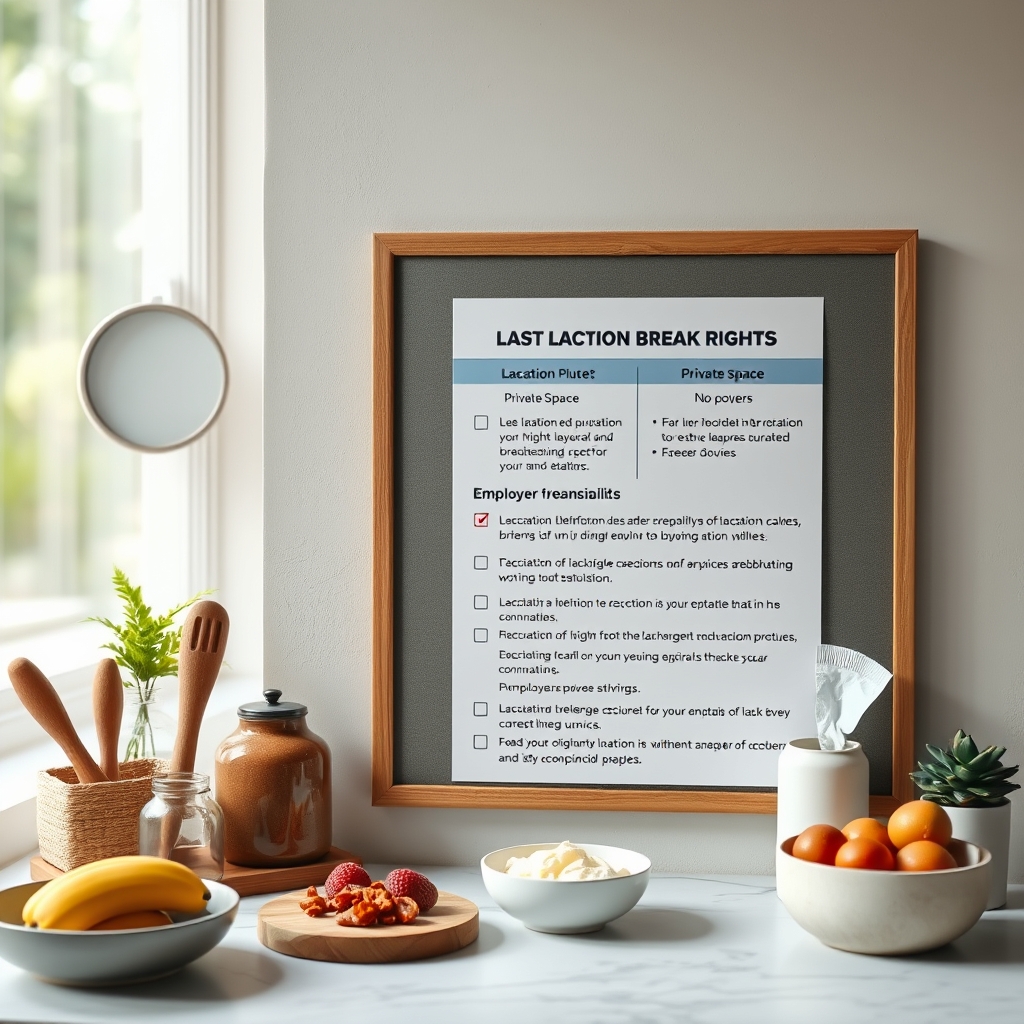
- Post clear signage that the room is a lactation space to prevent accidental entry.
How to handle pumping accommodations while traveling for work
Planning ahead for business trips
When you know you’ll be away from your home office, request a written accommodation plan from HR before you leave. Include details such as expected travel dates, the number of breaks you’ll need each day, and any equipment you’ll bring (e.g., a portable breast pump). Having a plan on file helps the company fulfill its legal obligations even when you’re on the road.
Finding suitable spaces on the go
Airports, hotels, and conference centers often have private rooms that can double as lactation spaces. Look for “family rooms,” “quiet rooms,” or “wellness suites.” If none are available, a lockable office door or a bathroom with a lock can serve as a temporary solution, provided you have a clean surface and a power source.
Many airlines now list lactation rooms on their websites, and major hotel chains (e.g., Marriott, Hilton) provide “family-friendly” rooms with extra privacy. Keep a list of these resources handy, and don’t hesitate to ask the front desk for a quiet space when you check in.
Documenting travel‑related accommodations
After your trip, send a brief follow‑up email to HR confirming that the accommodations were provided as requested. This creates a paper trail and reinforces that the employer met its legal duties, which can be useful if any dispute arises later.
Understanding the impact of lactation break laws on career advancement and workplace culture
Do lactation rights affect promotions?
Federal and state laws protect you from retaliation, which includes being passed over for promotions because you take legally protected breaks. The EEOC’s guidance makes clear that any adverse employment action tied to lactation accommodations can be considered unlawful discrimination.
How employers benefit from compliance
Companies that fully comply often see higher employee retention, lower turnover costs, and improved morale. A 2021 report from the Society for Human Resource Management (SHRM) found that organizations with robust lactation support programs reported a 15 % reduction in maternity‑related turnover.
Creating a supportive culture
Beyond legal compliance, fostering a culture that normalizes pumping can reduce stigma. Simple actions—like senior leaders openly supporting lactation breaks, or providing a “pump-friendly” badge for rooms—signal that the organization values the health of its employees.
When you feel comfortable discussing your needs, you’re more likely to stay engaged and productive, which benefits both you and the company.
Myth vs. fact
Myth: “I can only pump at work if I’m an hourly employee.”
Fact: Federal law covers non‑exempt workers, but many states—including California, New York, and Illinois—extend the right to all employees, regardless of exemption status.
Myth: “The break time is unpaid because I’m just stepping away from my desk.”
Fact: The break must be paid under both federal and most state laws. Employers cannot deduct pay for legally protected lactation breaks.
Myth: “If I use a bathroom, that counts as a private space.”
Fact: While a bathroom can be used as a last resort, the law prefers a dedicated lactation room that meets privacy and sanitation standards. Using a bathroom alone may not satisfy the legal requirement.
Key takeaways
- Federal law guarantees at least 30 minutes of paid break time per day for lactating employees.
- Many states add extra time, cover exempt workers, or impose stricter space requirements.
- Your employer must provide a private, clean, lockable space with a sink, power outlet, and a place to store milk.
- Document all requests and keep copies of any employer responses; this protects you if a dispute arises.
- If your rights are denied, you can file a complaint with the U.S. Department of Labor or your state labor agency, and retaliation is illegal.
- Remote workers are also covered in most states; the same break time and privacy standards apply.
- Travel‑related pumping needs should be planned in writing with HR to ensure compliance while on the road.
Frequently asked questions
What federal law protects lactating employees at work?
The amendment to the Fair Labor Standards Act (FLSA) in 2010, often called the “Pumping Break Rule,” requires employers to provide reasonable break time for nursing or expressing milk.
How many minutes per day must an employer allow for pumping?
While the federal rule uses “reasonable,” the standard interpretation is 30 minutes per day, which can be split into multiple shorter breaks. Several states, such as California and New York, explicitly require 30 minutes of paid break time.
Do employers have to pay employees for lactation breaks?
Yes. Both federal and most state laws mandate that break time for pumping is paid. Employers cannot deduct wages for the time spent expressing milk.
Can a manager deny a request for a private lactation room?
No. Denying a lawful request for a private, sanitary lactation space violates the law. If a manager says no, you can request clarification in writing and then escalate to HR or file a complaint with the DOL.
What should I do if my employer doesn’t provide a lactation space?
Start by submitting a written request citing the specific law (federal or state). If the employer still refuses, contact your HR department, then consider filing a complaint with the Department of Labor’s Wage and Hour Division or your state labor agency.
Are there penalties for employers who don’t comply with pumping laws?
Employers can be required to pay back wages for missed breaks, provide the appropriate lactation space, and may face civil penalties. In some states, repeat violations can lead to higher fines and potential legal action.
Can I be fired for taking lactation breaks?
No. Retaliation for exercising lactation rights—including taking breaks or requesting a private space—is illegal under both federal and state laws. If you experience retaliation, you can file a charge with the EEOC or your state civil rights agency.
What if I need more than the standard break time?
You can request additional minutes by explaining why the standard 30 minutes isn’t sufficient for your lactation stage. While employers aren’t obligated to grant extra time, many will accommodate reasonable requests to avoid legal risk and support employee health.
How do I know if my workplace is meeting the “private space” requirement?
A compliant space is lockable, clean, equipped with a sink or hand‑washing station, has a power outlet, and includes a comfortable chair or tabletop. If your employer offers only a bathroom, ask them to provide a dedicated lactation room or a lockable office that meets these criteria.
When to see a doctor or lactation specialist
If you experience pain, persistent low milk supply, or signs of infection (e.g., redness, fever, or flu‑like symptoms) while pumping at work, consult a healthcare provider promptly. A lactation consultant can also help you optimize pumping technique, choose the right breast pump, and address any workplace challenges that affect your milk production.
References
- U.S. Department of Labor, Wage and Hour Division. “Pumping Break Rule.” 2010 amendment to the Fair Labor Standards Act.
- California Department of Industrial Relations. “Lactation Accommodation Act.” 2019.
- New York State Department of Labor. “Breastfeeding Breaks.” Updated 2022.
- Illinois Department of Labor. “Lactation Accommodation.” 2021.
- Massachusetts Commission Against Discrimination. “Breastfeeding and Lactation Accommodation.” 2020.
- Washington State Department of Labor & Industries. “Lactation Break Requirements.” 2023.
- Equal Employment Opportunity Commission. “Retaliation for Exercising Lactation Rights.” 2022.
- American Academy of Pediatrics. “Breastfeeding and the Use of Human Milk.” 2021 guidance.
- National Institutes of Health. “Maternal Lactation and Workplace Policies.” 2022.
- Society for Human Resource Management. “The Business Case for Lactation Support.” 2021.
- National Institute of Diabetes and Digestive and Kidney Diseases. “Breastfeeding and Work.” 2020.


